
Wire laser cladding: a technical guide to wear, corrosion and buffer layers

Most metal parts fail at the surface long before the core gives out. A pump shaft corrodes at the seal, a trencher segment loses its cutting edge to rock, a glass mold wears at the joint line. The bulk of the part is still sound, yet the whole component goes to scrap or waits weeks for a replacement.
Cladding solves this by putting a high-performance alloy only where the part needs it. Wire laser cladding does it with a laser-generated melt pool and standard welding wire, producing a dense layer that is metallurgically bonded to the base metal with low dilution and a small heat-affected zone.
This guide covers what cladding is, the three jobs it does in industry, why dilution decides whether a clad layer works, how the main cladding processes compare, and how Meltio’s wire-laser metal deposition (W-LMD) technology handles each step, with data from published industrial projects.
Key takeaways
- Cladding deposits a functional alloy onto a base metal to resist wear, corrosion or heat, or to create a transition layer between incompatible metals.
- The quality of a clad layer depends heavily on dilution: how much base metal mixes into the deposit. Lower dilution keeps the clad alloy’s properties intact.
- Wire laser cladding combines the low heat input of a laser with the clean handling and full material use of wire feedstock.
- In a published hardfacing project, Meltio’s process reached an average dilution of about 5% to 10% with no spalling or cracking.
- In a glass mold project, a CNC hybrid setup with Meltio cut total processing time from 88 to 27 minutes per unit.
1. What is cladding in metal manufacturing?
Cladding is the deposition of a metal layer onto a metal substrate to give the surface properties the base material does not have. The substrate carries the load and keeps the part affordable. The clad layer handles the hostile part of the job: abrasion, impact, chemical attack, high temperature or sliding contact.
In laser cladding, a laser melts a shallow pool on the substrate surface while filler material is fed into it. As the pool solidifies, the filler and a thin film of base metal fuse into a single metallurgical bond. Overlapping beads cover the surface, and further layers build thickness.
The terms around cladding often get mixed up, so it helps to separate them:
Term | What it means | Bond type |
Cladding | Depositing a functional alloy layer onto a substrate, usually for corrosion, wear or heat resistance | Metallurgical (fused) |
Hardfacing | A subset of cladding focused on wear: abrasion, impact, erosion, galling | Metallurgical (fused) |
Weld overlay | The arc-welding term for cladding, common in oil and gas and pressure equipment | Metallurgical (fused) |
Thermal spray coating | Molten or semi-molten particles sprayed onto a prepared surface | Mainly mechanical adhesion |
Repair (dimensional restoration) | Rebuilding worn or damaged geometry, often in the original alloy | Metallurgical (fused) |
The line between cladding and repair is thin in practice. Many repair jobs finish with a clad layer that makes the restored part tougher than the original. For the repair side of the process, see our technical guide to metal part repair with wire LMD.
TIP: New to the process? Start with what laser metal deposition is.
2. The three jobs cladding does in industry
Wear protection (hardfacing)
Hardfacing protects parts that lose material to abrasion, impact or erosion: digging and cutting tools, crusher and mining wear parts, forging dies, valve seats. The clad alloy is usually harder than the substrate, either because of its own microstructure (cobalt-based alloys such as Stellite 6, tool steels such as H11 or AISI M7) or because it carries hard particles in a tougher matrix, as in tungsten carbide reinforced nickel alloys.
The engineering challenge is to add hardness without adding brittleness. A hard layer that cracks or spalls under impact fails faster than the bare steel it was meant to protect.
Corrosion and heat resistance
In oil and gas, chemical processing and power generation, components made from carbon or low-alloy steel are clad with nickel alloys or stainless steels so the wetted surface can survive the process medium. Inconel 625 is the standard choice for many corrosion-resistant overlays, and Inconel 718 is used where strength at temperature matters.
Here the clad layer is a chemical barrier. Its performance depends on its chemistry at the surface, which is why dilution control matters so much (more on that in section 3).
Buffer layers and transitions
Some combinations of base metal and functional alloy do not bond well directly. High-carbon substrates such as cast iron tend to crack, and some dissimilar pairs form brittle intermetallic phases at the interface. A buffer layer, often nickel or stainless steel, sits between the substrate and the top layer to absorb the metallurgical mismatch.
Buffer layers also help with white metals. Babbitt alloys used on sliding and bearing surfaces have very different melting behavior from the steel shells they sit on, and the interface needs careful control.

Up to 40% in cost savings compared to traditional manufacturing
3. Dilution: the number that decides whether a clad layer works
Dilution is the share of base metal that melts and mixes into the clad deposit. On a cross-section, it is commonly calculated as:
Dilution (%) = melted substrate area ÷ (clad area above the original surface + melted substrate area) × 100
Some dilution is necessary. Without it there is no fusion, and the layer can delaminate. Too much, and the clad alloy gets watered down by the base metal.
The effects of high dilution depend on what the clad is for:
- Corrosion overlays: iron from a steel substrate migrates into a nickel alloy overlay and lowers its corrosion resistance. To reach the required chemistry at the surface, high-dilution processes often need extra layers, which means more filler, more time and more heat into the part.
- Hardfacing: the substrate dilutes the matrix and can dissolve hard particles such as tungsten carbides, which reduces hardness and wear life.
- Dissimilar metals: more mixing increases the risk of brittle intermetallic phases at the interface, which hurts fatigue resistance.
Dilution is mainly a function of heat input and how that heat is distributed. A laser concentrates energy in a small, well-defined spot, so it can melt just enough substrate to form a sound bond. This is the main metallurgical reason laser cladding is chosen over higher-heat arc processes for demanding overlays.
In Meltio’s published trencher hardfacing project, the process reached an average dilution of about 5% to 10%. At that level, the nickel matrix and tungsten carbides kept their intended hardness and abrasion resistance.

Webinar
Watch this webinar to learn more about Laser Cladding and Repair by leveraging Meltio’s state-of-the-art wire LMD technology.
4. Cladding processes compared
Several processes can clad a metal surface. Each has a place, and the right choice depends on part size, alloy, required precision and the cost of the material being deposited.
Process | Heat input | Typical dilution | Bond | Feedstock use | Main limitations |
Arc weld overlay (GMAW, SAW, GTAW) | High | High | Metallurgical | High | Distortion, wide heat-affected zone, often several layers to reach surface chemistry |
Plasma transferred arc (PTA) | Medium to high | Medium | Metallurgical | Medium to high (powder) | Powder handling, heat input still significant on thin or sensitive parts |
Thermal spray (e.g. HVOF) | Low on the substrate | Improbable with Heat treatment | Mainly mechanical | Lower (overspray) | Bond strength limits under impact, porosity, thin layers |
Powder laser cladding | Low | Low | Metallurgical | Lower (not all powder enters the melt pool) | Powder cost and safety measures, powder recovery, process complexity |
Wire laser cladding | Low | Low | Metallurgical | Full (wire goes into the melt pool) | Line of sight required, alloy must be available as wire |
Wire laser cladding sits in a useful middle ground. It keeps the low heat input and low dilution of laser processes while removing the cost and handling burden of powder. The wire goes directly into the melt pool, so the expensive alloy is used in full. Operators handle spools of commodity welding wire rather than fine metal powder.
The limits are real and worth stating. The laser and wire need line of sight to the surface, so deep bores and internal channels require access or a different approach. And the alloy has to exist as wire. Cored wires have widened that list considerably: carbide-filled wires, for example, make tungsten carbide hardfacing possible with wire feedstock.

Wire laser cladding keeps the low heat input and low dilution of laser processes while removing the cost and handling burden of powder. The wire goes directly into the melt pool, so the expensive alloy is used in full. Operators handle spools of commodity welding wire rather than fine metal powder.
5. How Meltio performs wire laser cladding
Meltio’s technology was designed for building near-net-shape parts, and the same features that make it stable for printing make it well suited to cladding. Here is what happens at the deposition head and why each element matters for a clad layer.
Coaxial wire feed with multiple lasers
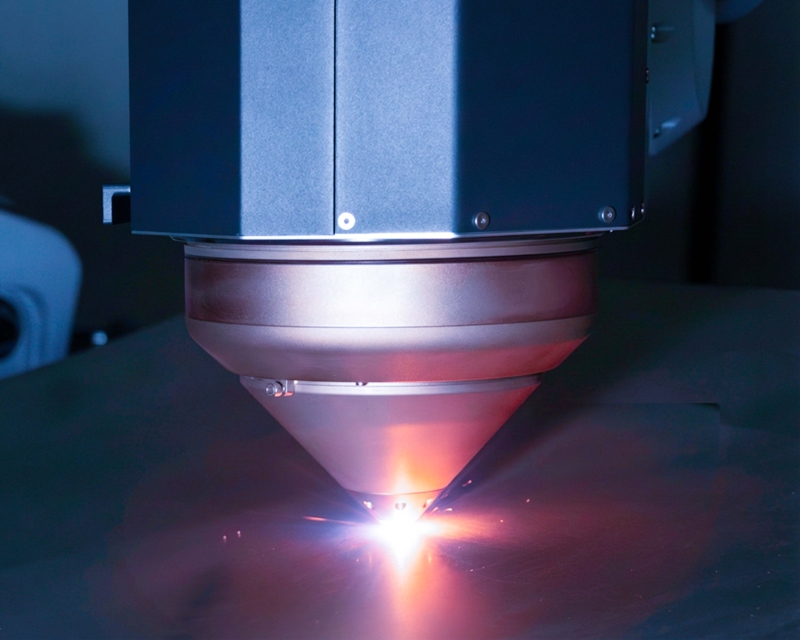
Meltio’s patented deposition head feeds the wire through the center of the melt pool, with several lasers arranged symmetrically around it. Because the wire enters along the head’s axis, the process behaves the same whichever direction the head travels. This matters in cladding, where toolpaths follow curved surfaces, edges and contours rather than straight lines.
The symmetric laser arrangement also spreads energy evenly around the wire, which keeps the melt pool stable and the bead shape consistent.
Blue laser option
Meltio offers a blue laser head (450 nm, 9 direct laser diodes). Metals absorb this wavelength better than infrared, so less energy is needed per unit of deposited material. Meltio reports a higher deposition rate at similar energy consumption to infrared.
Real-time process control
The Meltio process control system monitors deposition continuously and adjusts the wire feed to keep the process stable. On real parts, surfaces are rarely perfect: there is residual wear, small height variations and fixturing tolerance. Dynamic adjustment makes the process less sensitive to these variations and to toolpath precision. Integrated sensors and a vision system support this monitoring.
Low heat input and a small heat-affected zone
Laser energy delivery gives tight thermal control. For cladding, this has three practical effects: lower dilution, less distortion on thin or finished parts, and less need for long preheating and controlled cooling cycles on crack-sensitive substrates. In the glass mold project described below, it is what allowed the shop to return molds to service in hours rather than days.
Localized argon shielding
The head delivers argon locally around the melt pool to prevent oxidation. In the trencher project, deposition was shielded with 100% argon. Local shielding means large parts can be clad outside a sealed inert chamber.
Laser cleaning with the same head
Before deposition, the lasers can run a cleaning pass to remove surface oxidation. In the trencher project, this removed the need for aggressive mechanical grinding in some areas, shortening preparation and avoiding unnecessary material removal.
Multi-wire deposition
Meltio systems can feed one, two or up to four wires sequentially in a single job. For cladding, this opens up a buffer layer and a functional top layer in one setup, or different alloys on different zones of the same part: a corrosion-resistant alloy where the part meets the process fluid and a hardfacing alloy where it sees abrasion.
TIP: See how Meltio’s process reaches up to 99.97% relative density.
Validated cladding materials
Meltio uses commodity welding wire, and the system is open to third-party alloys. Materials validated for cladding and repair include:
Function | Alloys |
Hardfacing and wear resistance | Tool steel H11, Stellite 6, Stelloy 21, T Fe15, NiCarbW, AISI M7 |
Corrosion and heat resistance | Inconel 625, Inconel 718 |
Low-friction and anti-seizure surfaces | Babbitt alloys (white metals) |
Buffer layers and general tooling repair | Stainless steels such as 316LSi, 308 and 17-4PH |
Meltio also works with a dedicated materials partner on cored wires developed specifically for laser cladding and hardfacing, which extends the range of wear-resistant alloys available as wire. Browse the full range on the Meltio materials page.
6. Choosing a Meltio platform for cladding
The deposition technology is the same across Meltio’s range. What changes is the motion system around it, and that decides which parts you can clad efficiently.
Platform | Best suited for | Why |
Tolerance-critical surfaces: molds, dies, seats, sealing faces | Cladding and machining in one setup and one coordinate system, with the rigidity of a machine tool | |
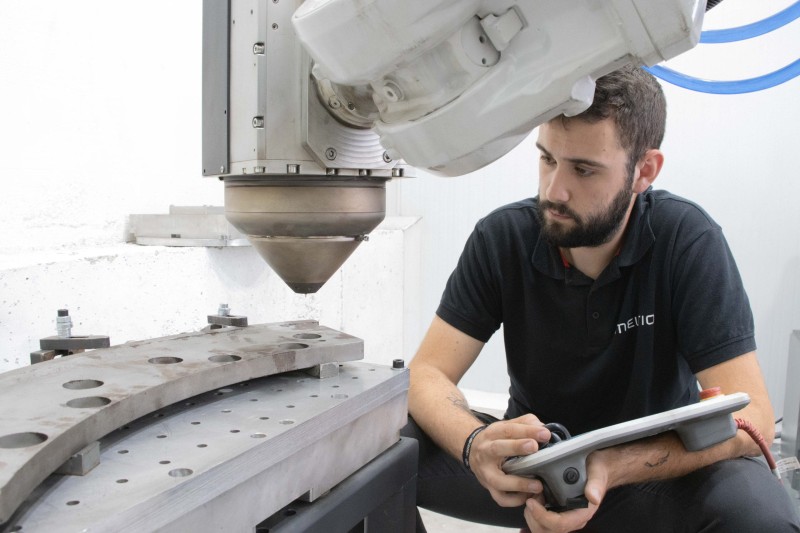
Large or curved parts: wear segments, shafts, rolls, large housings | Six-axis motion follows complex surfaces, and the work envelope scales with the robot and positioners | |
Shops that want robotic cladding as a ready-to-run cell | Pre-integrated robot, deposition head and safety enclosure | |
Smaller components, material trials and procedure development | Standalone printer for near-net-shape parts, repair and feature addition |

For mold repair and other jobs with tight dimensional tolerances, a CNC hybrid setup is usually the better choice because the part never leaves the machine between deposition and finishing. For large, curved or heavy parts, a robot gives the reach and flexibility the job needs.
7. The wire laser cladding workflow, step by step
A repeatable cladding job follows a defined sequence. This protocol is based on the steps used in Meltio’s published projects.
- Evaluate the part and the substrate. Identify the base material and its condition. Dilution can only be managed if the substrate chemistry is known. High-carbon materials such as cast iron need a buffer layer and suitable parameters.
- Prepare the surface. Remove oxidation, contamination and any damaged or fatigued material. A laser cleaning pass can replace part of the mechanical grinding.
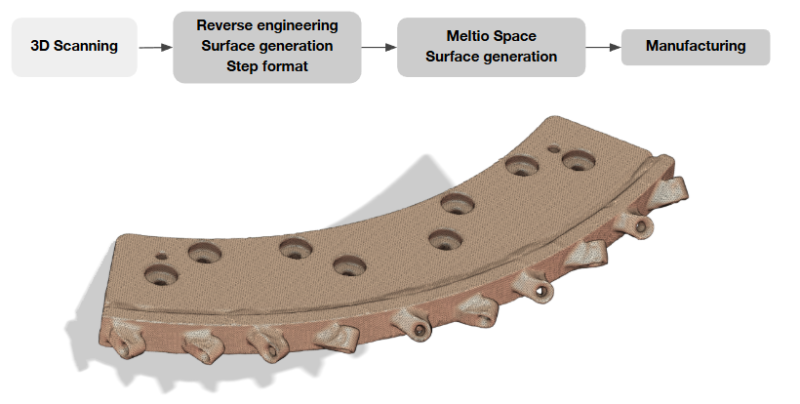
- Capture the geometry. Scan worn or irregular parts and reconstruct them digitally to generate an exact mesh for the toolpath.
- Locate the part. On a CNC hybrid, centering follows standard milling protocols. On a robot, reference points on the fixture triangulate the part’s position in the robot’s coordinate system.
- Generate the toolpath. In Meltio Space, define bead overlap, layer count and orientation so the clad covers the target zone with machining allowance.
- Deposit the buffer layer (if needed). Apply nickel or stainless steel on substrates that do not bond well with the functional alloy.
- Deposit the functional layer. Clad the wear-, corrosion- or heat-resistant alloy under local argon shielding.
- Finish the surface. Wire laser deposition produces a near-net-shape layer. A light machining or grinding pass brings it to final dimensions and surface finish.
- Inspect and verify. Typical checks include visual and dye-penetrant inspection for cracks, hardness testing, and cross-sections on qualification coupons to measure dilution and bond quality.
8. Industrial cladding applications with Meltio
Wire laser cladding is already in use where surface failure has a direct cost in downtime and spare parts. The two projects below are published Meltio use cases with measured results.
Trencher segment hardfacing (civil engineering)
Trenchers and wheel saws cut narrow channels for cables and pipes through rock, abrasive soil and debris. The cutting segments wear fast and are treated as consumables, which means frequent spare purchases and lost working time.
Traditional arc hardfacing brings high heat input and high dilution, plus a risk of spalling and cracking from uneven thermal gradients. The goal for this project was a dense, uniform layer of cast tungsten carbides in a nickel-based matrix (NiCarbW-LD), with low dilution and no cracking on a curved geometry.
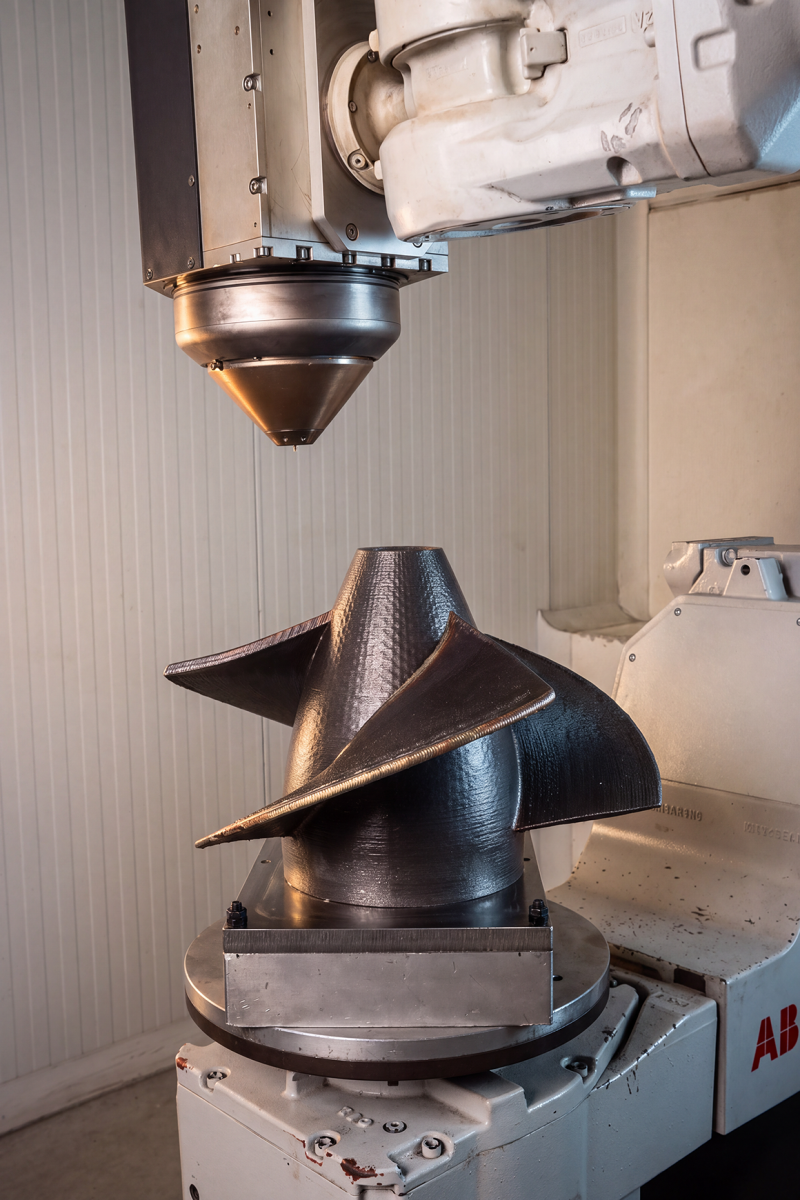
Working with Meltio’s materials partner for hardfacing and cladding, the team applied a two-layer hardfacing using the Meltio Engine robot integration. The part was laser cleaned, scanned, located with a three-point calibration and clad under 100% argon.
- About 5% to 10% average dilution
- No spalling or cracking observed after deposition
- 100% of the wire deposited, with no material lost to overspray or chips
The carbide overlay gives the segment more abrasion resistance than the original OEM specification, so the part goes back into service reinforced rather than simply restored.
Glass mold joint restoration (tooling)
Glass container molds are bimetallic. The body is usually cast iron, chosen for thermal conductivity and cost, while the joint areas and edges carry a hard-faced layer that resists abrasive clamping and thermal cycling. Restoring those interfaces with oxyacetylene welding meant heavy heat input, long preheating and cooling cycles, and six separate process steps.
A Spanish mold repair workshop integrated a Meltio Engine into its CNC machine, creating a hybrid cell that deposits and machines in one setup. Low heat input reduced the need for aggressive preheating, and buffer layers of nickel or stainless steel gave a sound bond to the cast iron.
- 88 → 27 minutes total processing time per unit
- 20 → 11 minutes machining time
- 6 → 2 process steps
- €38/kg → €10/kg feedstock cost, from specialized powder to commodity welding wire
- 5 → 2 technicians required
- 2–3 days → hours mold turnaround

Where else wire laser cladding fits
Based on Meltio’s validated materials and the failure modes they address, wire laser cladding applies to:
Oil and gas and process industries
Nickel alloy overlays on valve bodies, seats, stems and shafts exposed to corrosive media. See Meltio for mining, oil and gas.
Mining and heavy industry
Hardfacing of digging, crushing and conveying parts that wear by abrasion and impact.
Tooling
H11 and other tool steels on forging dies, trimming tools and molds that fail from thermal fatigue and wear.
Rotating equipment
Babbitt on sliding bearing surfaces, and corrosion or wear layers on shafts and journals.
9. Engineering checklist before a cladding project
Before requesting a cladding trial, it helps to have answers to these questions. They shape the alloy, the layer strategy and the platform.
- Substrate: what is the exact base material, and is its condition known (heat treatment, previous welds, contamination)?
- Failure mode: is the surface failing by abrasion, impact, erosion, corrosion, thermal fatigue or galling? Often it is a combination.
- Service conditions: operating temperature, process medium and loading.
- Final thickness: how much clad needs to remain after machining?
- Access: can the laser and wire reach the surface in a straight line?
- Buffer layer: does the substrate and clad combination need a transition layer?
- Heat treatment: does the part need pre- or post-clad heat treatment?
- Qualification: does your sector require a qualified overlay procedure? Pressure equipment and oil and gas applications commonly qualify corrosion-resistant and hardfacing overlays under codes such as ASME Section IX.

Conclusion
Cladding lets engineers specify the expensive alloy only where the part needs it, and keep the rest of the component in a material that is cheaper and easier to machine. The process used to apply that layer decides how much of the alloy’s performance survives.
Wire laser cladding keeps dilution and heat input low while using clean, low-cost wire feedstock in full. Meltio’s coaxial multi-laser head, real-time wire feed control, local argon shielding and multi-wire capability turn that into a repeatable process, on a CNC machine for tolerance-critical surfaces or on a robot for large and curved parts.
The published results point the same way. A trencher hardfacing job reached about 5% to 10% dilution with no cracking, and a glass mold workshop cut processing time per unit from 88 to 27 minutes while moving from €38/kg powder to €10/kg wire. As maintenance teams move from replacing parts to reinforcing them, cladding is becoming a production process rather than a last-resort fix.
TIP: Have a part that keeps failing at the surface? Talk to Meltio’s applications team about a cladding trial, or explore Meltio for repair.
FAQs
Wire laser cladding is a directed energy deposition process in which a laser melts a metal wire onto a substrate to form a metallurgically bonded surface layer. It is used to add wear, corrosion or heat resistance, or to create buffer layers between incompatible metals. Compared with arc processes, it has lower heat input and lower dilution.
Hardfacing is a type of cladding focused on wear resistance against abrasion, impact or erosion. Cladding is the broader term and also covers corrosion-resistant overlays, heat-resistant layers and buffer layers.
Dilution is the share of base metal that mixes into the clad deposit. Some is needed for a sound bond, but too much changes the clad alloy's chemistry, reducing corrosion resistance or hardness. In a published Meltio hardfacing project, wire laser cladding reached an average dilution of about 5% to 10%.
Both produce low-dilution, metallurgically bonded layers. Wire feeds directly into the melt pool, so all the material is used, and it avoids the cost, handling and safety measures that fine metal powder requires. Powder offers a wider choice of alloy blends. For alloys available as solid or cored wire, wire is usually the simpler and more economical option.
No. Laser cladding melts the filler and a thin layer of the substrate to form a fused, metallurgical bond. Thermal spray coatings bond mainly mechanically, which limits their resistance to impact and spalling.
Yes, with suitable parameters and a buffer layer. Cast iron's high carbon content makes it prone to cracking, but the laser's controlled heat input combined with a nickel or stainless steel buffer layer allows a sound metallurgical bond, as shown in glass mold restoration.
Validated cladding and repair materials include tool steel H11, Stellite 6, Stelloy 21, T Fe15, NiCarbW, AISI M7, Inconel 625, Inconel 718, Babbitt alloys and stainless steels such as 316LSi, 308 and 17-4PH. The system is open to third-party welding wires.
Yes. Meltio systems can feed up to four wires sequentially, so a buffer layer and a functional top layer, or different alloys on different zones, can be deposited in a single setup.
Usually, yes. Wire laser deposition produces a near-net-shape layer close to final geometry, and a light machining or grinding pass brings it to final tolerance and surface finish. On a CNC hybrid setup this happens without moving the part.
The Meltio Engine for CNC suits tolerance-critical surfaces such as molds, dies and sealing faces, because cladding and machining happen in one setup. The Meltio Engine for industrial robots and the Meltio Robot Cell suit large or curved parts. The Meltio M600 suits smaller components and procedure development.