

Mol-Matric turns three aluminum parts into one titanium piece


Mol-Matric spends most of its time building dies, tooling, and precision metal components, not aircraft structures. So when a new project landed on the table in early 2025, it came with an unusual brief: take a structural component built from three separate aluminum parts assembled together, and turn it into a single, lighter piece in titanium.
The project sat inside SAFE-AIR, an initiative focused on developing more sustainable aerostructures through additive manufacturing and advanced post-processing. For Mol-Matric, it meant proving something specific: that wire-laser metal deposition could produce a real structural part for the aeronautics sector, in titanium grade 5, not a lab demonstrator.
The margin for error was small in both directions. Get the redesign wrong and the part fails a mechanical test. Get the process wrong and an expensive titanium build, dozens of hours on the machine, is wasted before it ever reaches a test bench.
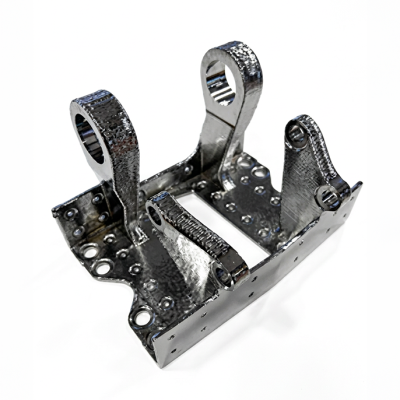
“To achieve this, we use additive manufacturing—more specifically, DED technology.
Unlike other additive manufacturing techniques, this technology allows us to work with medium- and large-sized parts, with very precise control over the energy input and extraordinary material efficiency.”
1. Three parts, one point of failure
In aerospace, weight is a direct cost: every kilogram removed from a structure is fuel saved over the life of the aircraft. The component Mol-Matric was asked to rework existed as an assembly of three separate aluminum parts. That meant multiple joints, each one a potential point of failure, and no easy way to shave more mass out of a design that had already been split into pieces for manufacturing reasons rather than structural ones.
Consolidating that assembly into a single part would remove the joints and open the door to real weight savings, but only if the replacement material and process could still meet the mechanical and functional demands of an aeronautic structural application. That’s a different problem than shaving weight off the same aluminum design. It called for a different material and a different way of building the part altogether.
2. Where titanium raises the stakes
Mol-Matric’s answer was titanium, specifically Ti6Al4V, titanium grade 5, the alloy aerospace engineers reach for when they need high strength at low weight. Redesigning the part through topological optimization made it possible to strip out non-functional material and consolidate the three original pieces into one monolithic structure. That solves the design problem. Building it is a separate one.
A topologically optimized geometry is generated to save weight, not to be easy to manufacture, and it has to be adapted to what wire-based deposition can actually build cleanly. Before committing to an expensive titanium build, Mol-Matric needed proof that the mechanical properties, the microstructure, the porosity level, and the surface integrity of the printed material would hold up under aerospace requirements. And once a good part came off the machine, it still had to be machined to tight dimensional tolerances and a demanding surface finish, on a geometry that didn’t resemble anything cut from a conventional billet.

3. Two tracks of validation before the titanium build
Mol-Matric sourced a Meltio M600 through Sicnova, Meltio’s distributor in Spain, and built its process around wire-laser metal deposition, also known as L-DED or wire-DED. Unlike powder-based processes, wire-DED feeds metal wire into a laser-generated melt pool, which gives precise control over the energy delivered to the part and high material efficiency, particularly valuable on a component of this size. Material only goes where the design calls for it, instead of starting from a solid block and cutting the rest away. The team worked two tracks in parallel.
Material side
They printed and tested dedicated specimens before touching the final geometry: tensile tests, hardness tests, and structural characterization, alongside checks on microstructure homogeneity, porosity, and surface integrity. Nothing moved forward until the titanium met the mechanical bar the application required.
Geometry side
Rather than risk the first attempt in expensive titanium, Mol-Matric printed trial models of the redesigned part in 316L stainless steel on the same M600. That confirmed the new geometry, the internal transitions and features the topological optimization had generated, could actually be built with wire-DED before a single gram of titanium wire went into the machine.
Both tracks checked out
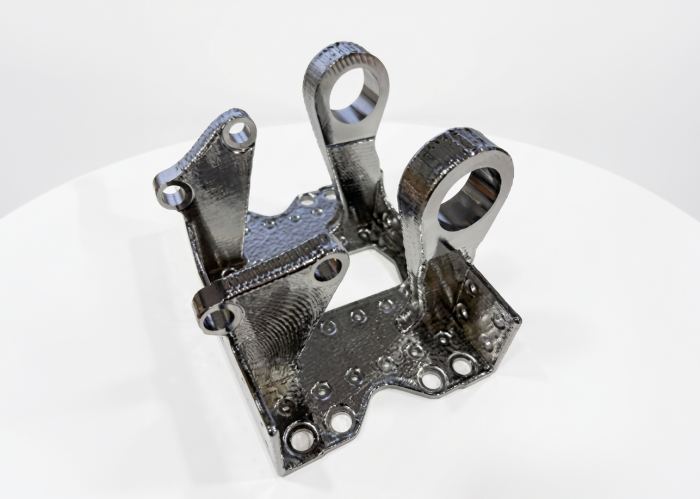
Mol-Matric printed the final part: a 9.90 kg titanium component measuring 249 x 380 x 218 mm, built under localized argon shielding at a flow of 20 liters per minute, over roughly 62 and a half hours. Printing was only half the job. The team then developed and optimized a dedicated machining route, testing different cutting strategies, tools, and conditions to hit the dimensional tolerances and surface finish the part needed, on a geometry that had never existed as a single piece before.
4. 27% lighter, one piece instead of three
27% lighter component vs original
3 vs 1 consolidated parts
A hybrid workflow, additive manufacturing followed by precision machining
A conventional multi-part build with something lighter, structurally simpler, and made in a material aerospace engineers already trust
5. From tooling shop to aerospace supplier
For a company built around dies, tooling, and precision components, this project marks a foothold in a different kind of manufacturing: aerospace structures built with additive technology from the outset, rather than machined from solid stock. It’s Mol-Matric’s first validated aerospace structural part, and the first in-house proof that wire-DED can carry that kind of application through mechanical validation and into a finished, machined component.
It also lands at a moment when the industry’s questions about additive manufacturing are shifting, from whether the technology can produce a good part to whether it can produce that part reliably, on a production floor, at scale. A validated process, real mechanical data, and a demonstrator that replaces three parts with one are exactly the kind of evidence that shift requires. And since every kilogram removed from an aerostructure is fuel not burned over the life of the aircraft, the case for this kind of work only gets stronger as the aerospace sector looks for ways to build lighter.
FAQs
The project set out to reduce the structural weight of the component while meeting the mechanical and functional requirements of an aeronautic application. Titanium grade 5 (Ti6Al4V) offers the strength-to-weight ratio needed for that, and combined with topological optimization, allowed the three original aluminum parts to be consolidated into a single, lighter titanium piece.
The final titanium demonstrator weighed 27% less than the original aluminum assembly, while consolidating what had been three separate assembled components into one monolithic piece.
Printing trial models in 316L let Mol-Matric confirm that the redesigned geometry could actually be built with the wire-DED process, before committing to a titanium build. It's a lower-cost way to validate geometry and process settings ahead of working with a more expensive and less forgiving material.
Yes. Post-print machining is where the part reaches the dimensional tolerances and surface finish an aeronautic structural component requires. Mol-Matric tested different cutting strategies, tools, and machining conditions to find the balance between quality and production efficiency for this specific geometry.
SAFE-AIR is a project focused on developing more sustainable aerostructures through additive manufacturing and advanced post-processing. Mol-Matric led the research and validation of wire-based L-DED for structural titanium aeronautic components within the project.