

Metal additive manufacturing in university motorsport engineering


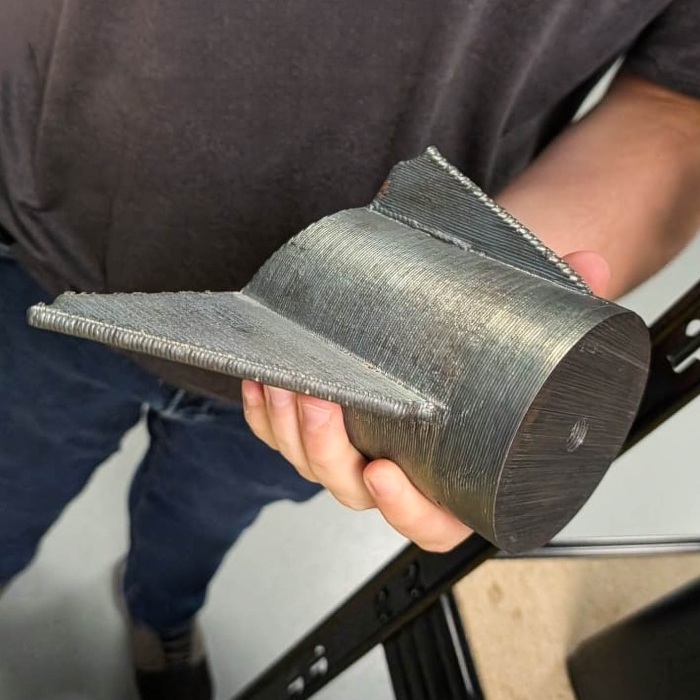
The chassis section that came off the Meltio M600 at the University of Greater Manchester replaces an assembly of four separate pieces. The main body and both gussets took just under 10 hours to build, and the only manual step in the whole process was lifting the main body off its first build plate. It is a small, practical example of what metal additive manufacturing in university motorsport engineering can do when the part is real and the questions are commercial.
The component belongs to an electric trials car that the university’s Centre for Advanced Manufacturing (CfAM) is developing with the National Centre for Motorsport Engineering. The team wants to find out whether cars like this could be sold as kits for competitors to assemble themselves. That changes how you think about every weld and every jig on the chassis.
Getting to that point started with a setback: the Centre lost one of its two metal processes when the company behind it closed.
“To achieve this, we use additive manufacturing—more specifically, DED technology.
Unlike other additive manufacturing techniques, this technology allows us to work with medium- and large-sized parts, with very precise control over the energy input and extraordinary material efficiency.”
1. When a closed metal system reaches end of life
CfAM grew out of the National Centre for Motorsport Engineering. The university began investing in 3D printing roughly seven to eight years ago to support motorsport teaching, and as those courses expanded, so did demand for additive manufacturing, materials testing and design work.
The Centre now covers additive manufacturing, reverse engineering, design and manufacturing, materials testing and metrology. It sits within the School of Engineering and Built Environment but serves students and staff across the whole university, from foundation level to doctoral research. It also runs commercial and R&D projects for clients in motorsport and automotive, oil and gas, power and medical applications.
On the additive side, CfAM runs several polymer technologies and Selective Laser Melting (SLM) for metal. For a while it also operated a second metal system. That process was slow, and it depended on expensive feedstock and consumables locked to the machine’s manufacturer. When the manufacturer closed, the system became obsolete overnight, and the Centre was left without the feedstock, consumables or support it needed to keep running.
For a facility that has to serve lecturers, researchers and paying clients from the same equipment, that is a real exposure. It is also a lesson that applies far beyond universities: if a metal AM process depends on a single supplier’s proprietary materials, the supplier’s future becomes your problem.
2. Finding a second metal process to work next to SLM
The team was clear on what SLM already did well. It suits fine-detail components and stayed in place for that work. The gap was everything SLM is less suited to.
CfAM set out three requirements for the replacement:
- Faster parts, through a higher deposition rate
- Feedstock that is easy to source and not tied to one vendor
- More flexibility in how components are built and worked on, including cladding for modification and repair
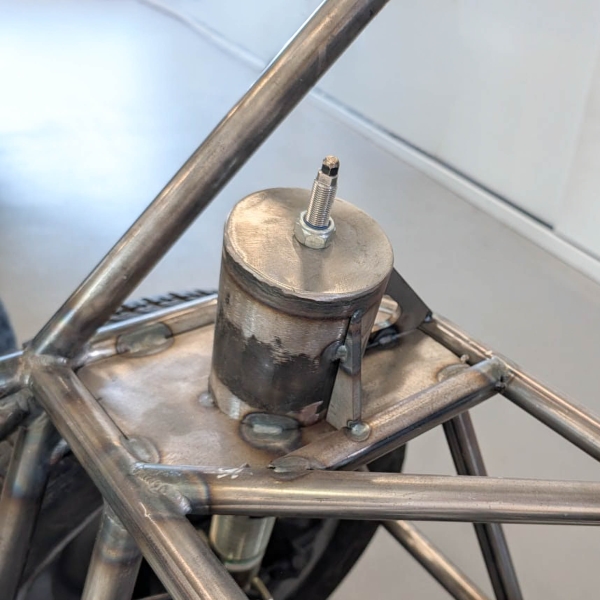
A test case was already waiting in the motorsport programme. The trials car’s chassis included a section fabricated as a four-piece assembly. Built conventionally, a part like this relies on CNC plasma-cut pieces, several welded joints and the jigs and fixtures that hold everything in alignment while it is welded. In a workshop, that is routine. In a kit sold to a competitor, every one of those steps moves to someone working in their own garage, with their own tools and their own margin for error.
The question for the new process was whether it could take that section, rebuild it digitally and produce it in metal with fewer parts and fewer manual steps.
3. Two tracks of validation before the titanium build
CfAM chose the Meltio M600, a wire-laser metal deposition (W-LMD) system in the Directed Energy Deposition (DED) family. The M600 feeds metal welding wire into a melt pool created by lasers and builds the part layer by layer. Compared with SLM, this gives the Centre a faster deposition rate, wire feedstock it can buy without being tied to the machine maker, and the ability to deposit material onto existing components for cladding, modification or repair.
The Centre currently prints in 17-4 stainless steel and mild steel, and plans to add materials as projects call for them.
For the trials car chassis section, the workflow ran in five steps:
1. Scan
The original prototype chassis section was captured with a Creaform HandySCAN 3D scanner.
2. Reverse engineer
The scan data was converted into a parametric CAD model, so the design could be edited rather than only copied.
3. Split for printing
The model was divided into three bodies: a main body and two gussets.
4. Print the main body
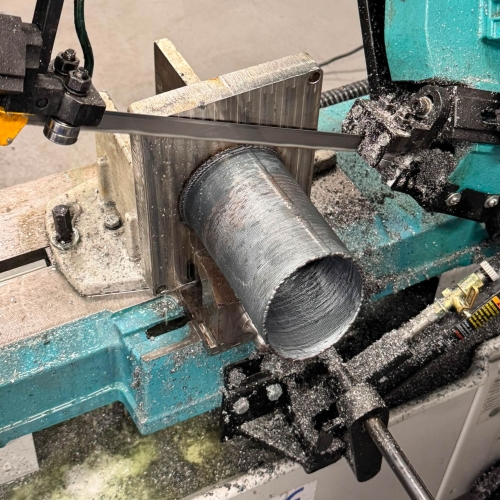
The main body was built on the Meltio M600.
5. Add the gussets
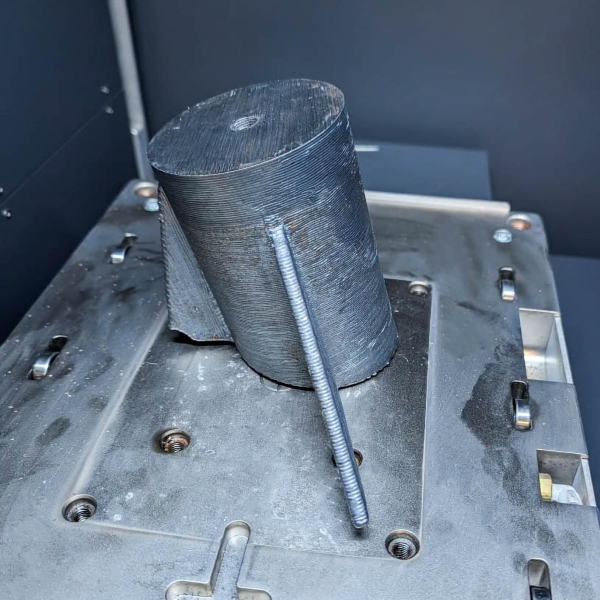
The team printed a 90-degree indexing jig on the M600, directly onto a plate, and used it to add the gussets in the correct orientation.
The total build time for the main body and both gussets was just under 10 hours. Apart from removing the main body from the first build plate, no step in the build was manual.
The fourth and fifth steps deserve a closer look. The fixture that positioned the gussets came off the same machine as the part itself. When the tooling can be printed on the machine that needs it, a new part does not have to wait for a separate fixture to be designed, machined and delivered.
4. What printing the chassis section changes
The project was set up to test geometry and build time, and both held up. The commercial benefits are still being assessed, but the team has identified where the approach could change how the chassis is made, sold and supported.
For a manufacturer producing the chassis
- Outsourced CNC plasma-cut parts may no longer be needed for this section.
- Fewer welded assemblies mean fewer places where misalignment can creep in.
- Dedicated welding jigs and fixtures could be removed from the process.
For a competitor building the car from a kit
- Fewer welding operations make assembly simpler.
- Every weld removed from the kit is one less chance for a builder to make an error.
For spares and inventory
- Components could be printed when they are needed rather than held in stock.
- That matters most for suspension components on trials cars, which are the parts the team flagged as the best fit for on-demand production.
For the Centre itself
- A second metal process that runs on accessible wire, with no locked feedstock or consumables.
- A build route where scan data becomes a printed metal part in a single working day.
5. From one chassis part to a resource for teaching and industry
With the geometry proven and the build time established, CfAM is now working on the numbers: what the printed section costs to produce and where it breaks even against the conventional route. In parallel, the team is building its DED expertise by testing new materials and refining parameters and build strategies.
Materials are the next step. Titanium and Inconel are among the alloys the Centre is considering to support upcoming projects in oil and gas, defence and food. Interest is already arriving from outside motorsport, with enquiries from aerospace, heavy industry and defence.
The M600 is also part of how the Centre teaches. Students use it on live projects, and CfAM’s CPD courses in additive manufacturing now include DED techniques, workflows and integration, taught on the machine alongside the Centre’s other AM processes. Engineers who train at CfAM leave knowing how to choose between SLM and DED for a given part, which is exactly the decision industry will expect them to make.
The chassis section has shown what the process can build. The break-even figure the team is working on now will show whether that part belongs in production.
FAQs
At the University of Greater Manchester, metal additive manufacturing is used to reverse engineer, redesign and print functional vehicle components, such as a chassis section for an electric trials car. The Centre for Advanced Manufacturing combines SLM for fine-detail parts with a Meltio M600 wire-DED system for faster builds, and it uses the same equipment for student projects, CPD training and commercial R&D.
DED and SLM cover different jobs, so running both widens what a lab can produce. At the University of Greater Manchester, SLM handles high-detail components, while the Meltio M600 wire-DED system offers a faster deposition rate, wire feedstock that is easy to source, and the ability to clad existing parts for modification or repair.
The original prototype chassis section was scanned with a Creaform HandySCAN, converted into a parametric model and split into a main body and two gussets. The main body was printed on a Meltio M600, and the gussets were added using a 90-degree indexing jig that was also printed on the M600, directly onto a plate.
The main body and both gussets took just under 10 hours to build on the Meltio M600. The only manual step in the build was removing the main body from the first build plate.
The Centre for Advanced Manufacturing currently prints 17-4 stainless steel and mild steel on its Meltio M600. Titanium and Inconel are among the next materials under consideration, to support upcoming projects in oil and gas, defence and food.
Yes. The Centre for Advanced Manufacturing integrates the Meltio M600 into teaching and makes it available for live student projects, and it delivers CPD courses that cover DED techniques, workflows and integration. The Centre also takes on commercial and R&D work for sectors including motorsport, automotive, oil and gas, power and medical.