

Manufacturing a Monolithic Part with Built-In Cooling Channels


The Meltio Value Proposition
When compared to other metal AM technologies and traditional methods, ACNS chose Meltio’s industrial metal wire-laser technology for several distinct advantages:
Wire instead of Powder: Wire is inexpensive, available in certified grades, fully deposited, and completely safe. It can be used in an ordinary workshop without the need for hazardous powder handling or dedicated, isolated facilities.
Laser instead of Arc: The laser process provides a finer bead and lower heat input compared to WAAM (Wire Arc Additive Manufacturing). This results in far better dimensional control and less machining stock.
Open Integration instead of a Closed Machine: Meltio provides the deposition engine, and ACNS builds the cell around it. Because the head integrates onto a standard industrial robot (like FANUC), the build envelope is as large as the robot’s reach. Furthermore, deposition and machining can be combined within the exact same cell.
As an automation and robotics integrator rather than a direct parts producer, ACNS utilizes its Meltio cell for development, qualification, demonstrations for prospects, and creating feasibility parts for customers and academic partners.
The decision to rely on Additive Manufacturing (AM) technologies stems directly from customer demands that conventional manufacturing struggles to address. These include large parts required in small quantities, the replacement of worn parts with long lead times, one-off tooling, and crucially, internal geometries that traditional machining simply cannot reach. For ACNS, AM does not replace machining and welding; rather, it perfectly complements them.
The Innovation: Breaking Free from the Drill
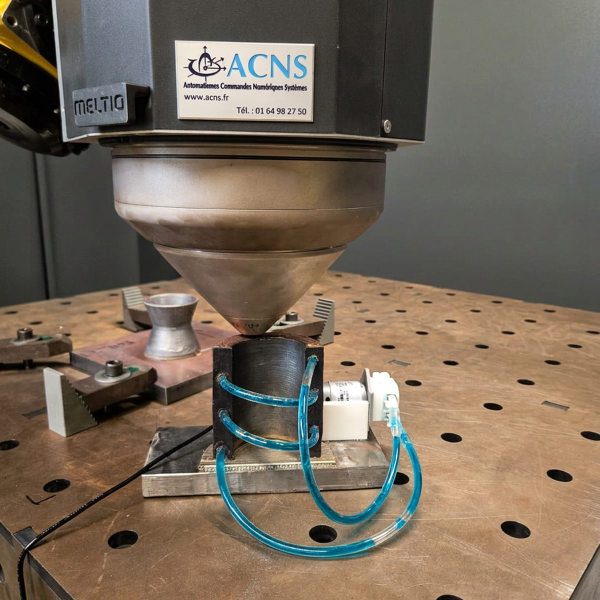
In this demonstrator project, ACNS targeted a universal industrial challenge: thermal management. The capability demonstrated applies across various sectors, enabling conformal cooling of moulds and tooling, cooled housings and manifolds in energy and process equipment, and cooled mechanical parts for high-performance applications.
Traditionally, cooling channels are dictated by what a drill can reach, resulting in a compromised design that often requires a drilled circuit, plugs, and a sealed cover.
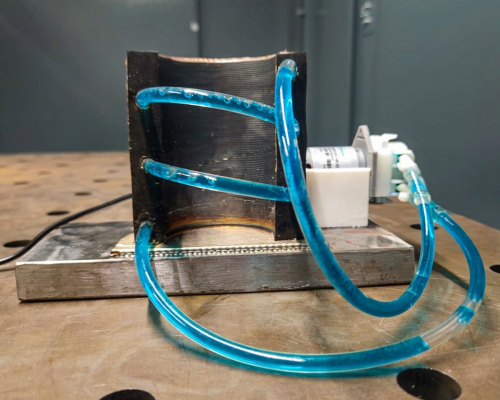
With Meltio’s technology, the cooling channel is built during the deposition process, naturally following the surface that needs to be cooled. One monolithic part replaces a complex multi-part assembly. The result? Fewer leak paths, reduced part references, and the complete elimination of sealing and assembly operations. Cooling is finally a pure design choice, not a manufacturing compromise.
Cost Savings and Industry Impact
While exact cost savings are not quantified—as this is a demonstrator with no customer baseline part or series volume—the structural savings are clear. Cost reductions naturally stem from:
The complete removal of assembly and sealing operations.
A significantly reduced part count.
Savings on material that no longer needs to be machined away.
Furthermore, because the Meltio head runs on a standard industrial robot, a workshop can adopt this cutting-edge process without needing a specialized powder facility or highly specialized AM operators. The very same cell can also be utilized to repair and rebuild existing worn parts.
Is it meant for Mass Production?
When asked if they would recommend Meltio technology for long series manufacturing of industrial metal parts, ACNS is clear: traditional methods like casting, forging, and machining still win on high volumes.
However, Meltio is highly recommended for unit parts, small series, large components, the repair of high-value parts, and complex internal geometries—just like this monolithic cooling cylinder—that conventional manufacturing routes simply cannot produce.
FAQs
At the University of Greater Manchester, metal additive manufacturing is used to reverse engineer, redesign and print functional vehicle components, such as a chassis section for an electric trials car. The Centre for Advanced Manufacturing combines SLM for fine-detail parts with a Meltio M600 wire-DED system for faster builds, and it uses the same equipment for student projects, CPD training and commercial R&D.
DED and SLM cover different jobs, so running both widens what a lab can produce. At the University of Greater Manchester, SLM handles high-detail components, while the Meltio M600 wire-DED system offers a faster deposition rate, wire feedstock that is easy to source, and the ability to clad existing parts for modification or repair.
The original prototype chassis section was scanned with a Creaform HandySCAN, converted into a parametric model and split into a main body and two gussets. The main body was printed on a Meltio M600, and the gussets were added using a 90-degree indexing jig that was also printed on the M600, directly onto a plate.
The main body and both gussets took just under 10 hours to build on the Meltio M600. The only manual step in the build was removing the main body from the first build plate.
The Centre for Advanced Manufacturing currently prints 17-4 stainless steel and mild steel on its Meltio M600. Titanium and Inconel are among the next materials under consideration, to support upcoming projects in oil and gas, defence and food.
Yes. The Centre for Advanced Manufacturing integrates the Meltio M600 into teaching and makes it available for live student projects, and it delivers CPD courses that cover DED techniques, workflows and integration. The Centre also takes on commercial and R&D work for sectors including motorsport, automotive, oil and gas, power and medical.