



A Meltio Engine on a HAAS 5-axis machine combines wire-laser deposition, in-process machining and closed-loop platinum recovery.
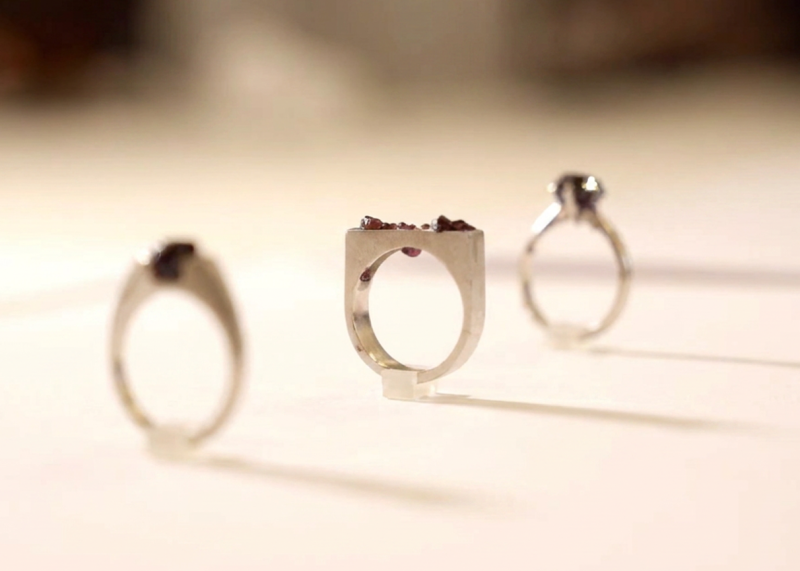
At the Centre for Print Research (CFPR), part of the University of the West of England’s Bridge Studios, a hybrid metal 3D printing and CNC machining setup is being used to answer a question no jeweller has really needed to solve before: how do you plant a crystal seed inside a solid metal structure while that structure is still being built?
The answer sits at the centre of CFPR’s neo-gemstone project, led by researcher Sofie Boons within an interdisciplinary studio that mixes jewellery, sculpture and manufacturing research under one roof. The idea is to grow rubies and sapphires in place inside platinum settings, rather than mining them or growing them separately in an industrial furnace. The seed for each new crystal comes from residual material, offcuts and waste from existing gemstones, planted inside the metal and left to grow around a structure engineered specifically to host it.
That idea only works if the seed survives the build. Casting, powder-bed printing and every other method CFPR tried before came up short.
This use case has been developed together by UWE Bristol, Meltio’s trusted partner 3DGBIRE and Create.
1. The origin problem behind every gemstone
Gemstones reach jewellery by one of two routes: mined from the ground, or grown in energy-intensive industrial facilities where the record of what went into a stone gets lost somewhere in the supply chain. Neither route sits well with a research group trying to build a case for gemstones with a documented, low-impact origin.
CFPR’s alternative, using leftover crystal material as a seed and growing gems directly inside a piece of jewellery, depends on physically placing that seed exactly where it needs to sit inside a metal part before the part is finished. Get the placement wrong and there’s no gem. Damage the seed during fabrication and there’s no gem either.
2. Why casting and powder-bed printing can’t place a seed
Investment casting
The traditional route for platinum jewellery, pours molten metal into a ceramic mould built around a wax pattern that’s burned out before the pour. Even without a seed involved, the process struggles with fine or open geometries: shrinkage as the metal cools and variability between pours make each casting cycle a small gamble, and every failed attempt means carving a new wax pattern and starting over.
It’s a process built for shape, not for holding something delicate in a fixed position while liquid metal moves around it. Seeds placed inside a mould get displaced by the flow of the metal, disturbed by buoyancy, or damaged by the thermal shock of the pour. Platinum makes all of this worse: its high melting point complicates mould removal, and a failed cast in a metal this valuable is an expensive write-off.
Powder-bed fusion
The other common route into metal 3D printing, has a different limitation. The part sits buried inside a bed of loose metal powder for the entire build, inaccessible until the machine finishes. There’s no way to reach in, place a seed at a specific depth and orientation, and then keep building around it.
What CFPR needed was a process open enough to interrupt mid-build, precise enough to place a seed exactly where the design called for it, and clean enough that a material as valuable as platinum wouldn’t be lost to waste along the way.

3. Hybrid metal 3D printing and CNC machining, on one machine
CFPR built its answer around a Meltio Engine integration kit fitted to a HAAS 5-axis CNC machine, combining Meltio’s wire-laser metal deposition with in-process CNC machining in a single setup. Because wire-laser deposition builds a part in the open, layer by layer, from platinum wire fed into a laser-generated melt pool, rather than sealing it inside a bed of powder, the build stays accessible throughout. The team can pause deposition at the exact point the design calls for, place or adjust the seed by hand with a level of positional control casting and powder-bed printing don’t offer, then resume printing around it.
The same setup switches to subtractive machining without moving the part to a second station. Deposition and CNC finishing happen back-to-back on one machine, so there’s no intermediate handling and no re-fixturing to introduce fresh positional error after the seed has already been placed.
Researcher Michael White built the other half of the system: a material recovery loop for everything the process generates. A localised vacuum extraction system, controlled through the same G-code that drives the CNC cycle, captures platinum lemel and other machining by-products for reprocessing as they’re produced, instead of letting them scatter as swarf. For a metal that costs what platinum costs, that recovery loop isn’t incidental. It’s part of what makes the whole approach viable.

Wire-laser deposition also suits platinum on its own technical terms. The metal’s high melting point, a liability in casting, becomes an advantage in a mould-free process. The sustained, localised heat the deposition process delivers also matches what’s needed to support crystal growth around the seed once it’s in place.
4. What a hybrid setup gets you that casting can’t
Precision where it matters most
Getting the seed into the structure without displacing or damaging it, something CFPR couldn't reliably achieve with any prior method.
No error or waste
Building and finishing the platinum structure on one machine also removes the handling steps that introduce error or waste in a multi-stage workflow.
Material recovery
Because the vacuum extraction system captures machining by-products as they're generated, CFPR expects lower scrap and less reprocessing than a casting route would produce, along with full traceability over where the platinum in each part ends up. For a material this valuable, being able to account for it at every stage of the process carries weight on its own, separate from any cost figure.
5. From a research bench to a production case
The neo-gemstone project is still a research effort, not a finished production line, and CFPR is careful not to claim otherwise. But the underlying capability, pausing an additive build to place something inside it with precision, then finishing the part on the same machine, points past jewellery. Any application that needs to embed a sensor, a marker or a dissimilar material inside a metal structure runs into the same problem CFPR solved here.
That’s also where this sits inside Meltio’s own trajectory. Sitting within UWE Bristol’s School of Arts and its artists-in-residence programme, CFPR approaches the technology from a different angle than most Meltio partners, whose projects tend to come from defence, aerospace or heavy industry rather than a jewellery bench. That’s exactly why the result matters. W-LMD’s move from prototyping into industrial production depends on proof like this: a process validated in a demanding, unforgiving material by researchers with no commercial reason to overstate what it can do yet.
If CFPR’s approach holds up as the project matures, the case for hybrid deposition and machining gets built one seed at a time, and a manufacturing process first proven on a precious metal in a university studio has a way of finding its way into far less delicate applications later.
FAQs
A neo-gemstone is a ruby or sapphire grown in place inside a metal structure, seeded with leftover material from existing gemstones rather than mined or grown separately. Researchers at CFPR build a platinum structure using metal 3D printing, pause the build to place the seed at a precise point inside it, then continue printing so the crystal grows as part of the finished piece.
CFPR fitted a Meltio Engine integration kit to a HAAS 5-axis CNC machine, so the same setup handles both metal deposition and precision machining. The part is built additively from platinum wire, then machined to final geometry without moving it to a second station, removing the re-fixturing step that would otherwise reintroduce positional error.
Casting pours molten metal around the seed, and the flow, buoyancy and thermal shock of that pour can displace or damage it before the metal solidifies. Powder-bed 3D printing buries the part inside loose metal powder for the entire build, so there's no way to access it and place a seed at a specific point until the print is already finished.
Not yet. CFPR describes the project as still being actively tested and refined, with no production-scale process or cost model in place. The technical capability, placing a seed accurately inside a metal structure mid-build, is validated; scaling it into a repeatable production process is the next phase.
Platinum's high melting point, which makes casting harder because of mould removal and failed-cast losses, works in wire-laser deposition's favour instead, since the process doesn't rely on a mould. That same sustained, localised heat also supports the crystal growth CFPR relies on once a seed is in place.