


GARY Mécanique de Précision has been machining metal for more than 60 years. Its craft is subtractive: take a blank, cut it into a part that fits. Lately, the hard part has been getting the blank. Pressure on raw-material supply chains has made stock less predictable to source, and a machine shop waiting on its suppliers can only quote lead times it doesn’t control.
So GARY started producing blanks itself. The company now uses metal additive manufacturing to build blanks in-house and machine them on the equipment it already owns, to make parts with geometries that machining alone can’t reach, and to explore higher-value work such as repair and cladding of worn components.
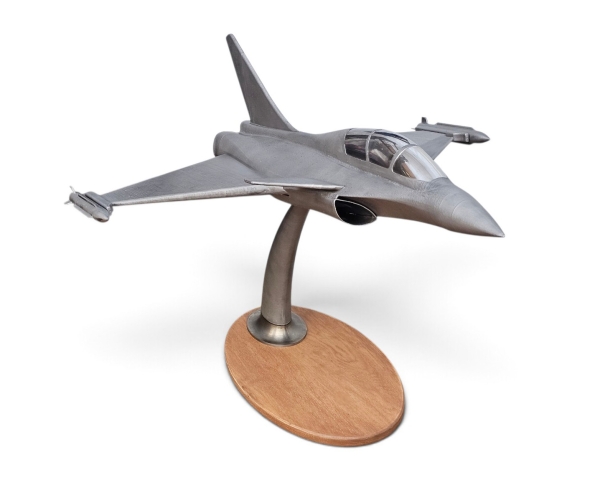
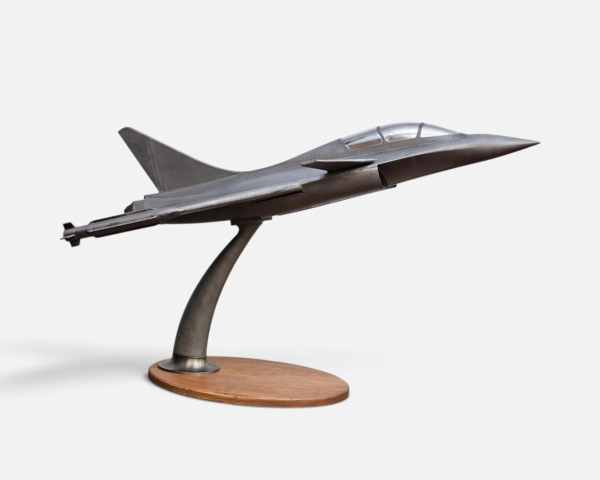
The most unusual part to come out of that workflow so far has no industrial function at all. It is an artistic replica of the Rafale fighter jet, about a metre long, made in 316L stainless steel for exhibition and sale as a work of art. It is also a clear demonstration of large-scale 316L stainless steel 3D printing done the way a machine shop would do it: print close to final shape, then machine only what matters.
The company now uses metal additive manufacturing to build blanks in-house and machine them on the equipment it already owns, to make parts with geometries that machining alone can’t reach, and to explore higher-value work such as repair and cladding of worn components.
1. A shape that conventional methods fight
A fighter jet replica is a difficult brief for any metal shop. The fuselage, wings and canopy curve in several directions at once, the surfaces flow into one another, and the part is large. GARY’s assessment was blunt: this level of geometric freedom would be extremely difficult or impossible to achieve through casting or conventional machining.
Each conventional route carries its own penalty. Casting needs dedicated tooling, and every design change means new tooling, which costs time and money before a single part exists. Machining a piece this size from solid would mean buying a large block of stainless steel and turning most of it into chips, with the deepest curves still hard to reach. And splitting the work across subcontractors (one for the blank, another for machining, another for welding) adds transfers, waiting time and cost at every handoff.
For a one-off artwork, those penalties make the project hard to justify. For a shop thinking about series production, they are the reason most complex parts stay on the drawing board.
2. Printing a hollow, curved, 20 kg part accurately
The finished Rafale measures 800 x 250 x 1000 mm and weighs approximately 20 kg. To keep material cost down, the structure is hollow, so the printed walls have to hold their shape over a large, curved surface.
Curvature is the core technical problem. Simple sections can be built with flat, planar layers. Steep and continuously curving surfaces cannot be built well that way, because each new layer would sit further and further off the one below it. The deposition head has to follow the shape, or the part has to move under the head.
Accuracy mattered just as much. The cockpit needed finish machining, so the printed geometry had to leave enough material to clean up, and not much more. Every extra millimetre of stock is extra machining time on a 5-axis centre.
Then there was the question of how to show the piece. GARY could not find an off-the-shelf display stand able to carry a 20 kg part, so the stand became a second engineering job.

For a one-off artwork, those penalties make the project hard to justify. For a shop thinking about series production, they are the reason most complex parts stay on the drawing board.
3. A Meltio Engine on a 6-axis robot, and machining under the same roof
GARY printed the Rafale entirely with a Meltio Engine robot integration kit mounted on a Fanuc 6-axis industrial robot, working with a 2-axis positioner. The process is wire-laser metal deposition (W-LMD), a form of Directed Energy Deposition: 316L stainless steel wire is fed coaxially into a melt pool created by multiple lasers, building the part layer by layer.
GARY chose wire-laser over arc-based wire deposition (WAAM) for specific reasons. In its view, Meltio’s configuration gives a good balance between deposition rate and print quality, with concrete advantages over WAAM in geometric accuracy and material quality, while keeping deposition capabilities suited to large parts. For a hollow part that has to land close to final shape, that accuracy is what makes the rest of the workflow possible.
The team combined three deposition strategies on a single part:
- Planar layers on the simpler sections.
- The deposition head tilted along the curvature, with the robot’s six axes moving in coordination to keep deposition optimal on curved surfaces.
- The part was reoriented between print sequences on the 2-axis positioner, so each region could be built from a favourable angle.
Total print time was under 100 hours.
After printing, the cockpit was finished on GARY’s Hermle 5-axis machining centre. Because deposition was accurate, the print left a maximum of 1.5 mm of stock to remove. That is what near-net shape means in practice: minimal material to buy, minimal material to cut away, and a short machining job.
Building the display stand in-house
The stand followed the same hybrid logic, in four steps:
- 3D design and a structural check to confirm it could carry the 20 kg part.
- Machining of the base and the attachment.
- Printing of a curved, hollow 316L tube with variable deposition, directly onto the machined base.
- Welding of the attachment onto the printed tube.
Design, printing, machining and welding were all carried out in-house, within GARY’s ISO 9001 and EN 9100 certified quality system.
4. Geometry, lead time and material where it counts
The Rafale shows what hybrid manufacturing delivers when printing and machining sit under one roof. The gains GARY identified map directly onto the problems that made the project hard:
Geometric freedom
Shapes that casting or conventional machining would struggle to produce, or could not produce at all, were printed directly.
Lower material cost
The hollow structure and near-net-shape deposition put material only where it is needed. GARY has not yet put a figure on the savings for this part.
Short machining
With at most 1.5 mm of stock to remove, machining was limited to functional surfaces.
No tooling
Without moulds or patterns, design changes are easy to make and lead times stay short.
No subcontracting delays
Keeping every step in-house removed the transfers between suppliers that add both cost and waiting time.
A path to series production
GARY notes that the process is repeatable, which opens the door to producing parts in series rather than as one-offs.
5. From a sculpture to series production
GARY is clear that artistic pieces are a side road. Development effort is focused on industrial markets, where the same capabilities apply to blanks, complex parts and, in the future, repair of worn components. Repair matters to GARY because industry is asking for more circular-economy practices, and rebuilding a part costs less material than replacing it.
Asked whether it would recommend Meltio technology for long series of industrial metal parts, GARY’s answer was yes, for large parts with a hollow structure and a planned post-processing step. It is equally direct about the limits: surface quality does not match powder bed fusion, but for complex, voluminous parts the geometric capabilities are significantly superior.
That candid trade-off is the useful lesson for other machine shops. Wire-laser deposition does not replace the 5-axis centre. It feeds it a blank that is already close to the finished part, made in-house, on demand. For a shop with 60 years of machining behind it, that is a way to stop waiting on raw material and start building the shapes customers ask for.
FAQs
Yes. GARY Mécanique de Précision printed a hollow 316L stainless steel Rafale replica measuring 800 x 250 x 1000 mm and weighing about 20 kg using a Meltio Engine mounted on a 6-axis industrial robot. Robot-mounted wire-laser deposition heads are not limited by a closed build chamber, which makes them suited to metre-scale parts.
Wire-laser deposition offers better geometric accuracy and material quality than arc-based wire deposition (WAAM), while still depositing enough material for large parts. GARY Mécanique de Précision chose Meltio's wire-laser process for this balance between deposition rate and print quality. Higher accuracy means less stock to machine away after printing.
It depends on the part, but wire-laser DED parts are typically printed near net shape and machined only on functional surfaces. On GARY Mécanique's 316L Rafale replica, deposition accuracy left a maximum of 1.5 mm of stock to remove, and the cockpit was finished on a 5-axis machining centre. That kept machining time short.
You combine deposition strategies so the head or the part follows the curvature. For the Rafale replica, GARY Mécanique used planar layers on simple sections, tilted the deposition head along curved surfaces with coordinated 6-axis motion, and reoriented the part between sequences on a 2-axis positioner. This lets each region be built from a favourable angle.
Hybrid manufacturing combines additive deposition and machining in one workflow: you print a part close to its final shape, then machine only the surfaces that need precision. GARY Mécanique de Précision designed, printed, machined and welded its 316L Rafale replica and display stand entirely in-house, which removed subcontractor transfers and cut both cost and lead time.
The system uses welding wire rather than metal powder, which fits well with TNB Remaco's existing welding and fabrication capabilities.
Yes, for large parts with a hollow structure and a planned post-processing step, according to GARY Mécanique de Précision. The process is repeatable, which supports series production. Surface quality does not match powder bed fusion, but geometric capabilities are significantly better for complex, voluminous parts.