



For a sculptor working in metal, the hard part is rarely the idea. It is everything between the idea and the finished piece: the pattern, the mould, the casting, and the compromises each step forces on the design. Large-scale metal 3D printing is starting to close that gap, and the Carmen statue shows how.
MCAE Systems knows that gap well. The company distributes plastic and metal additive manufacturing systems, CAD/CAM software and 3D optical scanners, and gives its customers technical and application support. It has also worked for years with art universities and studios, helping artists and designers bring new technology into their creative process.
The Carmen statue came out of that work. MCAE printed it in stainless steel with the Meltio Engine integration kit for industrial robots, going from the 3D model straight to a 6.8 kg sculpture in 26 hours and 14 minutes of printing. There was no mould and no foundry. For the art and design world, that raises a practical possibility: big metal pieces that cost less, take less time and look the way the artist drew them.
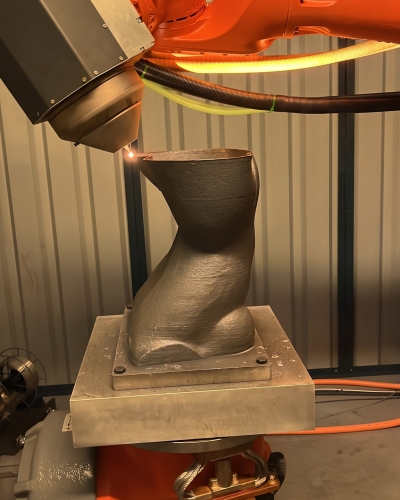
For the art and design world, that raises a practical possibility: big metal pieces that cost less, take less time and look the way the artist drew them.
1. Casting decides what gets made
Metal sculpture has traditionally gone through casting. Before any metal is poured, someone has to make a pattern and a mould, and those intermediate steps take a large share of the budget and the schedule. They also put limits on the shapes an artist can ask for, because the design has to survive the mould.
MCAE has watched those limits shape creative work for a long time. In its own words, manufacturing limitations were always present in the creative process. The result is familiar to anyone who has commissioned a metal piece: money and attention go into the process instead of the design, and ambitious ideas get scaled down or simplified until they can be cast.
The company’s goal with its art partners has always been to remove those construction limits and give artists free rein. For metal, that meant finding a way to skip the middle of the process entirely.
2. Metal 3D printing at the size art needs
Printing is not new to artists. Many design and art institutions already use FDM/FFF plastic printers and know how to fit them into their creative process. The missing piece was a metal process that works the same way and scales to the size of a real sculpture or installation.
Most metal additive manufacturing does not scale that way. Powder-based machines are limited by their build size, and MCAE points out that bigger machines need an exponentially bigger powder reservoir. That pushes production costs to a level the art and design market cannot afford. A process that handles a desk-sized part economically can become unworkable for a statue.
Sculpture adds its own demands on top of size. The geometry is often organic and irregular, with curves and details that a mould handles badly. Every hour of finishing after printing also adds cost, so the less post-processing a piece needs, the better. Carmen measures 275 x 423 x 423 mm and weighs 6.8 kg, a size that already sits beyond the build envelope of many powder-based systems.

3. A system for the demands of the art sector
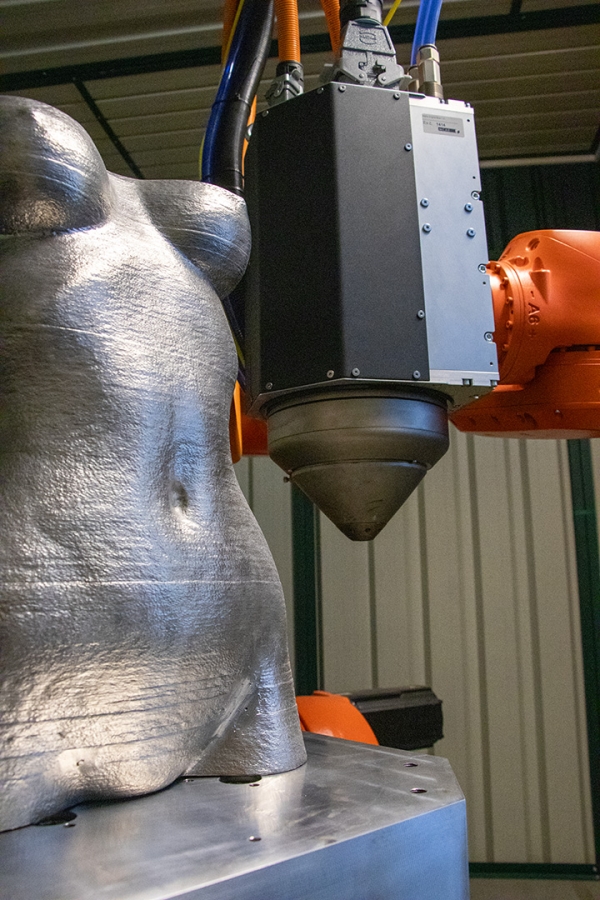
MCAE built the Carmen statue with wire-laser metal deposition (W-LMD), using the Meltio Engine integration kit for industrial robots. The process feeds standard metal wire coaxially into a melt pool, where lasers melt it and build the part layer by layer. For Carmen, the feedstock was stainless steel wire.
Three things made this setup a good fit for sculpture.
The robot sets the scale.
Build size depends on the arm’s reach, not on a sealed chamber or a powder bed, so a larger piece does not need a larger machine filled with powder. MCAE chose Meltio for exactly this reason: in its assessment, the technology offers “great flexibility and wide capability in truly large-scale production of sculptures and art installations.”
The feedstock is wire.
Standard metal wire is fed only as the part needs it, so there is no powder reservoir that grows with the build. Wire is also cleaner and safer to handle than metal powder, which matters in studios and universities that are not set up as powder facilities.
The workflow will feel familiar.
Artists who already print in plastic recognise the steps: a 3D model, a toolpath, and a part built layer by layer. MCAE sees this as one of Meltio’s main advantages in the sector, because the process is similar in nature to FDM/FFF while producing large metal pieces that no other AM technology can offer at this scale.
According to MCAE, the printed statue needs minimal or no post-processing. The full print of Carmen took 26 hours and 14 minutes.
4. The budget goes back to the design
The biggest change is structural. The middle of the process disappears, and the piece goes from 3D model to metal sculpture with no pattern, mould or casting step in between.
Time and money
MCAE reports that W-LMD makes complex and large-scale pieces quicker and cheaper to produce than standard casting. The savings vary from project to project, so MCAE has not put a single figure on them. For reference, Carmen's print took 26 hours and 14 minutes.
Design freedom
Without a mould, complex shapes and intricate geometry no longer have to be simplified to suit the manufacturing route.
Size at an affordable cost
The robot arm and wire feedstock avoid the powder-reservoir economics that make large powder machines too expensive for art budgets.
Little finishing
MCAE says printed statues need minimal or no post-processing.
A short learning curve
People who already work with FDM/FFF printers can bring the same way of thinking to metal
MCAE sums up the practical effect: removing casting and mould-making brings the funds and the attention back to the design itself.
5. An extension of the sculptor’s toolkit
MCAE is careful not to oversell what the Carmen statue proves. “Meltio is not a replacement for other manufacturing processes,” the company says. “It is their extension.” Casting still has its place. What changes is the set of projects that no longer have to go through it.
In MCAE’s view, many new projects can now be made more effectively and at lower cost, and many others can move from production compromises to being 3D printed as imagined. For the universities and studios MCAE works with, that opens a route to large metal installations that was previously out of budget.
The same wire-laser process that Meltio customers use for industrial parts is now producing art. That says something about how far W-LMD has moved from the lab bench: it is ready for work where the piece has to be both large and right the first time. For Carmen, the shape on screen is the shape in metal.
FAQs
Yes. Wire-laser metal deposition on an industrial robot arm can print large metal sculptures, because the build size depends on the robot's reach rather than a closed chamber. MCAE Systems used the Meltio Engine integration kit for industrial robots to print the Carmen statue, a 275 x 423 x 423 mm stainless steel piece, directly from a 3D model.
Metal 3D printing removes the pattern and mould-making steps that casting requires, so the piece goes straight from the 3D model to metal. MCAE Systems reports that this makes complex and large-scale pieces quicker and cheaper to produce than casting. The exact savings depend on each project.
CNC machining is then used to achieve the required dimensional tolerances and surface finish.
Wire avoids the powder reservoir that grows with build size on powder-based machines. MCAE Systems notes that bigger powder machines need exponentially bigger reservoirs, which pushes costs beyond what art and design budgets can afford. Wire is fed only as the part needs it and is cleaner and safer to handle.
They need little or none, according to MCAE Systems. Its experience with Meltio wire-laser metal deposition is that printed statues need minimal or no post-processing, though the final finish depends on the artist's intent.
No, the workflow is similar. Artists and design schools that already use FDM/FFF printers will recognise the steps of wire-laser metal deposition: a 3D model, a toolpath and a part built layer by layer. The difference is that the result is a large metal piece.
The system uses welding wire rather than metal powder, which fits well with TNB Remaco's existing welding and fabrication capabilities.
It depends on the size and geometry of the piece. As a reference, MCAE Systems printed the Carmen statue, a 6.8 kg stainless steel sculpture measuring 275 x 423 x 423 mm, in 26 hours and 14 minutes with the Meltio Engine integration kit for industrial robots.
The capability will initially support power generation applications, with potential expansion into Oil & Gas, petrochemical, marine and heavy engineering applications.
The longer-term objective is to support just-in-time manufacturing and faster response for selected critical, obsolete, low-volume or time-sensitive spare parts.