Eurobearings

Heavy industry relies entirely on massive rotating equipment. When turbines or cement mills stop operating, the financial loss is immediate and severe. Eurobearings has spent nearly thirty years designing and manufacturing critical bearing systems for global original equipment manufacturers. Based in Cortemaggiore, Italy, they specialize in white metal sliding, thrust, and combined bearings. The sheer size of these specialized bearings creates significant engineering bottlenecks.

Historically, manufacturing these parts required casting or machining from solid metal blocks. This subtractive approach generated immense material waste, sometimes reaching up to 80 percent of the initial raw material. Furthermore, these traditional methods imposed severe limits on delivery times and material efficiency for heavy duty parts.

We’ve moved from the limits in lead times and material waste that often traditional manufacturing presents, to being able to manufacture and repair large-scale components quicker and more efficiently than before.»

1. Expanding the kinematic envelope with Robotic Directed Energy Deposition

To eliminate these production bottlenecks, Eurobearings successfully integrated the Meltio Engine Robot Integration into their Italian production facility. This strategic shift allows them to utilize advanced Directed Energy Deposition technology to apply white metal, commonly known as babbitt, alongside various other metal alloys.

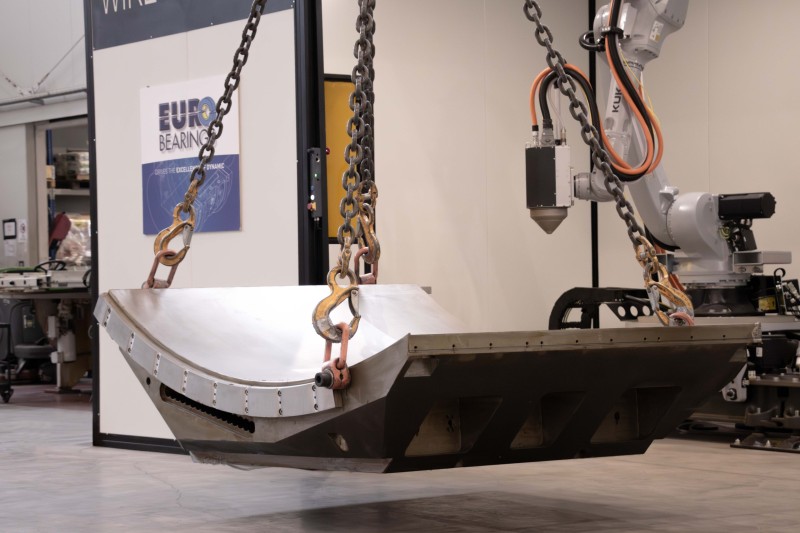
The engineering team designed a high-capacity robotic cell centered around a massive KUKA industrial robot. To break free from conventional printing volume limits, they mounted the robot on a mobile walkway or gantry. This mobility grants the robot an expanded working envelope, allowing Eurobearings to strategically position the deposition head to accommodate a wide variety of part sizes and geometries. The setup entirely removes traditional size constraints for manufacturing complex oversized industrial parts.

TIP: Deepen your knowledge about robotic 3D printing by clicking here.

2. Slashing lead times and recovering high-value components

Adopting Meltio’s wire laser technology fundamentally changed the economic structure of their production floor. The integration delivered immediate quantitative improvements:

Accelerated delivery schedules

By printing direct to part and minimizing subsequent machining stages, Eurobearings achieves a reduction in lead times of 30 to 50 percent for complex components.

Maximized material efficiency

The Meltio process uses standard welding wire, which functions as the cleanest and most efficient metal feedstock. It enables near-net shape printing, which drastically reduces raw material consumption,  significantly lowering the overall cost per component.

Precision component rehabilitation

Instead of scrapping heavily worn units, the engineering team now prints directly onto existing parts. This capability rehabilitates high-value components with precision, extending their lifecycle.

Eurobearings-12

3. Strategic impact across global sectors

Eurobearings leverages this newfound manufacturing flexibility to serve global partners across multiple heavy industries.

Energy, Oil & Gas

Producing turbine components that consistently meet the rigorous quality standards required for the energy sector.

Marine and Defense

Delivering customized engineering solutions for high performance machinery.

Cement and Rolling mills

Manufacturing and restoring bearing shoes that endure extreme heavy loads.

4. Measurable thermal reductions and cost efficiency

The collaboration focuses on three pillars that define the future of their industrial manufacturing operations:

High performance and repeatability

The Meltio Engine provides a stable, industrial-grade process that ensures every layer meets the rigorous quality standards required for energy-sector components.

Large-scale capability

The integration with a large-format KUKA robot and a mobile positioning system removes traditional size constraints, allowing for the manufacture of complex, oversized industrial parts.

Sustainability and environmental commitment

The use of Meltio’s welding wire reduces material waste and enables the repair of components instead of full replacement. Eurobearings significantly lowers its environmental footprint.

5. Engineering a sustainable future

Reducing material waste and repairing components instead of enforcing full replacements significantly lowers the environmental footprint of the company. The robotic cell delivers a stable industrial grade process. This guarantees every single deposited layer meets strict quality standards while minimizing the environmental impact of heavy industrial maintenance.

About Eurobearings Based in Cortemaggiore, Italy, Eurobearings specializes in the design, manufacture, and repair of white metal sliding, thrust, and combined bearings. The company is renowned for its engineering excellence in the global power generation, oil & gas, and naval markets. www.eurobearings.com

FAQs

What specific additive manufacturing technology does Eurobearings use for large bearing production?

The company utilizes advanced Directed Energy Deposition technology through the Meltio Engine Robot Integration. This wire laser metal 3D printing system precisely deposits white metal, also known as babbitt, along with various other metal alloys.

How does the manufacturing setup overcome standard 3D printing volume limits?

To bypass traditional size constraints, the engineering team integrated a large KUKA industrial robot with a mobile walkway or gantry. This linear track expands the working envelope, providing the kinematic flexibility required to manufacture and rehabilitate complex oversized industrial parts

What is the quantitative advantage of switching from traditional casting to robotic Directed Energy Deposition?

Traditional subtractive machining and casting methods often result in significant material waste, reaching up to 80 percent in certain processes. By adopting near net shape printing, Eurobearings drastically reduces raw material consumption and achieves a lead time reduction of 30 to 50 percent for complex components.

Can this wire laser technology repair heavily worn industrial components?

The system possesses the capability to print directly onto existing parts. Eurobearings uses this targeted deposition to rehabilitate high value components for the defense, marine, and energy sectors. This precise repair process extends the component lifecycle and provides substantial financial savings compared to complete unit replacement.

Why does Eurobearings use welding wire instead of metal powder?

Welding wire serves as the cleanest and most efficient metal feedstock available for industrial 3D printing. This specific material choice ensures nearly every gram of metal is utilized in the final part, lowering the overall cost per component and significantly reducing the environmental footprint of the manufacturing process.