cavaletto_meltio-06

Cavaletto Mario S.p.A. specializes in the hot forging, hot upsetting, and electrical upsetting of steel. Founded in 1967 by Aldo and Mario Cavaletto, the company currently operates with a workforce of approximately 70 employees.

The core production workflow begins with heating steel billets in induction furnaces to render the material deformable, followed by forming the parts using industrial machinery. The facility manufactures entirely in-house steel tooling to support these operations. Because they supply sectors such as earthmoving equipment, agriculture, industrial handling, hydraulic components, and automotive, the production matrix is highly complex.

The company actively manages the production of more than 5,000 different parts, varying heavily in both geometry and technical complexity.

“With over 5,000 different pieces in production, both in geometry and complexity, it was difficult to find an operator who would stay with us over the years and be able to repair all the diverse equipment we own.”

1. Labor shortages and reliance on specialized operators

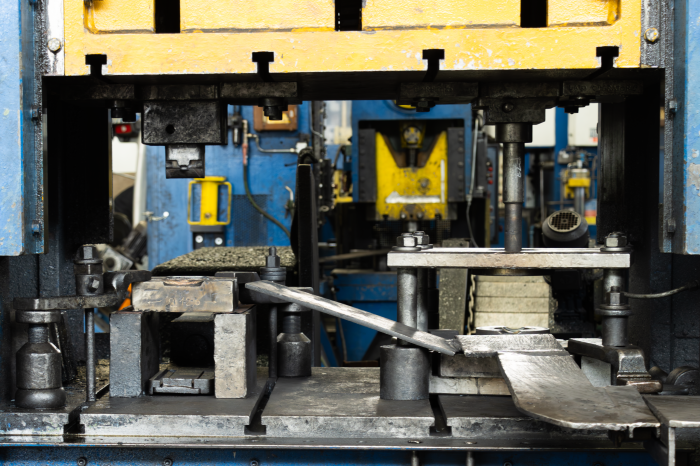
To achieve the final shape of the forged components, the production line requires trimming equipment to remove excess material or burrs. Over time, these trimming dies and punches experience wear and require constant maintenance.

Historically, Cavaletto relied on a single highly skilled welder with over 40 years of experience to perform these manual repairs. Finding an operator capable of repairing the diverse array of equipment and retaining them over the years proved exceptionally difficult. Training a new welder from scratch to master the manual repair of thousands of distinct tooling geometries is a process that requires years of investment.

The inability to easily replace or scale this specialized manual labor presented a strict bottleneck for the company’s continuous production.

2. Evaluating automated alternatives for complex geometries

The engineering team required a method to replicate the extensive know-how of their veteran welder using automated machinery. The solution needed to handle the geometric complexity inherent in their 5,000-part catalog. Additionally, the chosen process had to fulfill strict functional requirements for the tooling, specifically high heat resistance and high hardness.

Initially, Cavaletto evaluated a continuous wire welding solution. However, the complex geometries of their components rendered this conventional automated approach unfeasible.

Furthermore, traditional manual electrode welding generated slag between layers, which required manual cleaning and disrupted process continuity. The challenge was finding an additive manufacturing technology capable of providing the necessary thermal properties, geometric flexibility, and a clean deposition process.

“To be internationally competitive, we entrusted Meltio and its 3D printing technology for the repair of our pieces, which helps automate the welding and repair process.”

3. The Meltio process workflow for tool refurbishment

Through collaboration with Overmach, Cavaletto identified wire-laser welding as the optimal solution. The engineering team adopted Meltio technology to automate the previously manual welding process used for removing excess material and trimming equipment. This wire-laser technology provides greater flexibility, accuracy, and process control for their complex geometries.

The manufacturing workflow for a repaired component follows a strict procedure:

  1. Reference features are machined into the component to accurately locate the part on a fixture plate.
  2. The damaged weld is machined away to secure an optimal surface that matches the component geometry.
  3. The part undergoes Meltio deposition using specific welding wire supplied by a local manufacturer.
  4. Once the deposition is complete, the upper surface is machined flat to ensure correct positioning during the final forging phase.
  5. The component is cut using wire-cut EDM to achieve the final dimensions required for trimming the forged parts.

4. Operational improvements via Additive Manufacturing

By transitioning from manual electrode welding to the Meltio Robot Cell, Cavaletto achieved highly measurable operational improvements. The primary benefits include:

Quality and durability

The Meltio welds exhibit excellent durability and resistance under real-world conditions, performing similarly to the previous manual electrode welds.

Process cleanliness

The wire-laser additive manufacturing technology prevents the formation of traditional welding slag, eliminating the need to clean between layers.

Repeatability

The automated process provides consistent material deposition, improved accuracy, and strict repeatability compared to the original manual operations.

Knowledge retention

The technology allows the company to translate human expertise into machine parameters, bypassing the need to source and train new personnel for years.

Material efficiency

The company avoids significant material waste, achieving an estimated 67% material savings compared to traditional electrode welding. When comparing the complete conventional mold manufacturing technique, they report an estimated 20% savings in both the welding material required and the material subsequently removed during post-machining.

5. Validating LMD as the future of Oil and Gas component manufacturing

Integrating wire-laser metal additive manufacturing has fortified Cavaletto’s competitive advantage on an international scale. The organization successfully automated complex repair processes while maintaining the high material standards required for hot and cold steel forging.

While the upfront preparation time for creating 3D models and programming the Meltio Space software is currently slower, the overall repeatability and reduction in material waste validate the transition. Moving forward, the company plans to continuously refine the repair process to further reduce lead times. Once full control of the programming and cell setup is achieved, they expect the machine to operate continuously for tooling refurbishment.

“Thanks to Meltio, we save almost 67% of material compared to traditional electrode welding, and we gain other advantages such as repeatability and a much cleaner process by not needing to clean the slag between layers.”

cavaletto_6

FAQs

Why was continuous wire welding rejected for this application?

Continuous wire welding was evaluated but ultimately deemed unfeasible due to the complex geometries of the 5,000 different components manufactured by Cavaletto.

Did the Meltio system replace an existing process entirely?

Yes. Many tooling components that were historically repaired exclusively by hand are now processed using the Meltio system.

What post-processing is required after the metal 3D printing phase?

After deposition, the upper surface is machined to create a flat area. Subsequently, the component undergoes wire-cut EDM to reach the exact dimensions required for trimming the flash of forged parts.

Does the printed material meet the operational demands of hot forging?

Yes. The specific wires utilized provide high heat resistance and high hardness. Real-world testing confirms the Meltio welds deliver durability and resistance highly comparable to traditional manual welding.