
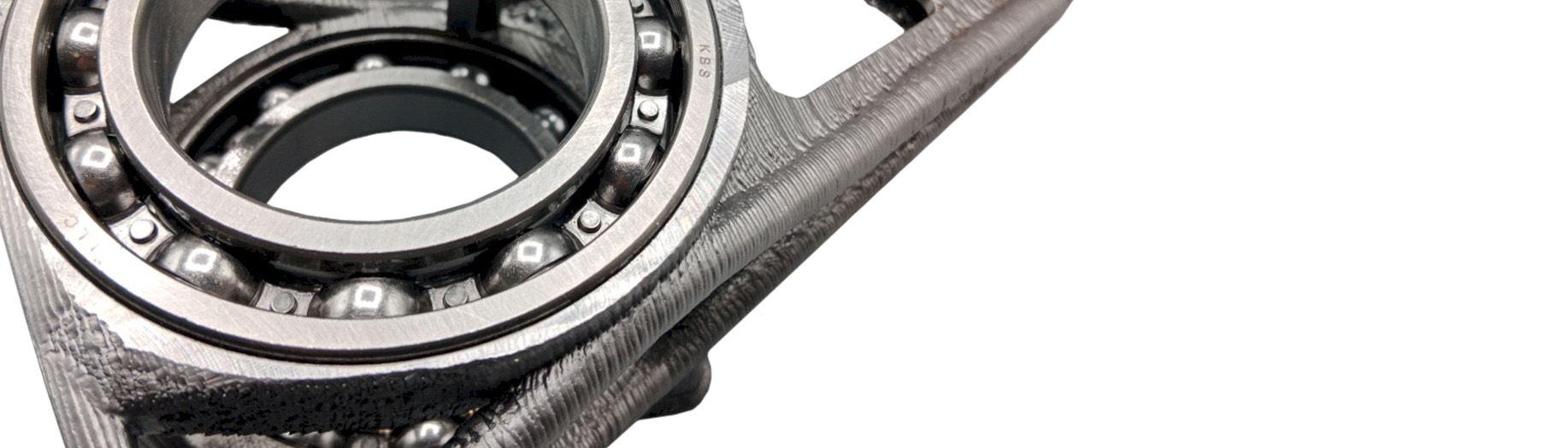

For decades, the engineering consensus was immutable: for structural integrity, you forge; for complex geometry, you cast; and for prototypes, you print. Additive Manufacturing (AM) was long relegated to the «good enough for form, bad for function» category due to historic issues with porosity, anisotropy, and unpredictable yield strengths.
That era is over.
At Meltio, we do not obscure the physics of our process. We utilize Wire-Laser Metal Deposition (W-LMD), a Directed Energy Deposition (DED) technology that fundamentally differs from powder-based systems or wire arc-based AM (WAAM). By feeding a solid metal wire into a focused laser melt pool, we achieve a metallurgical environment that produces parts with mechanical properties that not only rival but also exceed those of traditional casting standards and frequently forging standards.
This article deconstructs the data behind our density, tensile strength, and microstructural integrity, providing the engineering assurance required to transition from «prototyping» to «production.»
1. The physics of density: Why wire wins
Porosity is the enemy of fatigue life. In powder-bed systems, gas entrapment and un-melted powder particles often compromise density. Meltio’s approach is different. We use standard welding wire, a feedstock that is already fully dense and clean, eliminating the risk of interstitial gas porosity inherent to powder processes.
- 99.97% Relative Density: Our process consistently delivers parts with up to 99.97% relative density. This is verified through Computed Tomography (CT) scans and mostly and more detailed metallographic analysis.
- Contaminant-Free: Unlike powder systems, there is no binder to burn off and no risk of airborne cross-contamination. The result is a chemically pure melt pool, critical for reactive alloys like Titanium.
- NASA Standard Compliance: Our profiling development phases reference NASA-STD-6030 (Additive Manufacturing Requirements for Spaceflight Systems), targeting pore sizes below 100 µm and maintaining strict density controls and minimum 99,75% of relative density.
TIP: Discover how our process can achieve 99.97% relative density here.
2. Mechanical performance data
Engineers need numbers, not adjectives. Our internal testing and validation by independent laboratories show that Meltio printed parts often outperform their cast counterparts.
Superior strength vs. Casting
Due to the rapid cooling rates associated with the laser process, the microstructure of Meltio parts is exceptionally fine. This refined grain structure impedes dislocation movement, directly translating to higher strength.
- Tensile strength: Up to 144% higher than traditional casting methods.
- Yield strength: Up to 236% better than casting.
Material spotlight: Titanium 64 (Ti-6Al-4V)
Titanium is notoriously difficult to process due to its reactivity with oxygen.
- Oxygen content: Controlled between 0.095% and 0.450% depending on the laser profile, ensuring the material remains ductile and does not become brittle.Specifically, the range is adjusted according to the technology: for the IR (Infrared) profile, it remains between 0.250% and 0.450%, whilst for the Blue profile, it is optimised between 0.095% and 0.213%.
- Porosity: Maintained at less than 0.25% by volume, meeting stringent aerospace requirements.
Material spotlight: Inconel 718 & 625
For high-temperature applications, our nickel superalloys demonstrate ultimate tensile strengths superior to casting and WAAM, approaching the properties of wrought materials.
- Relative density:.respectively
- Infrared: 99.8% and 99.7%
- Blue Laser: 99.9% and 99.88%
- Defectology: Max pore size is strictly controlled/monitored during profile validation.

Superior strength vs Casting
- Tensile strength: Up to 144% higher than traditional casting methods.
- Yield strength: Up to 236% better than casting.
3. The anisotropy myth: Achieving isotropic behavior
A common criticism of layer-based manufacturing is weakness in the Z-axis (inter-layer bonding). In many extrusion-based technologies, this is a valid concern.
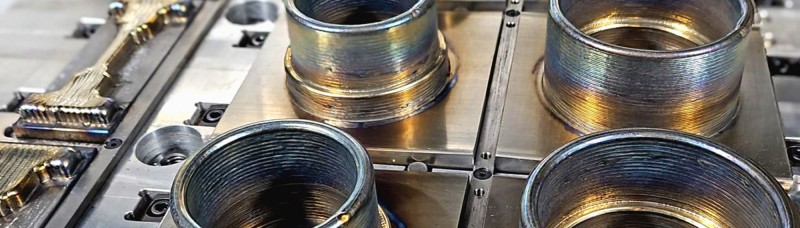
In Meltio’s W-LMD process, the high energy density of the laser ensures full metallurgical fusion between layers, not just adhesion. The heat-affected zone (HAZ) is compact, yet sufficient to re-melt the previous layer’s surface, creating a continuous grain structure across layer lines.
- Near-Isotropic Properties: Our thermal management strategies result in parts with mechanical properties that are nearly uniform in all directions (X, Y, and Z). Reducing as much as possible the gap between the horizontal and vertical plane.
- Thermal Homogeneity: Our standard «Solid» print profiles rotate the infill path by 45º every layer. This strategy prevents thermal stress accumulation and ensures uniform mechanical performance throughout the part volume.
TIP: Not familiar with Wire-Laser Deposition yet? Have a look here.
4. Surface quality and fatigue resistance
Mechanical properties are not just about the internal bulk; surface finish plays a critical role in fatigue crack initiation.
- Surface roughness: We achieve as-printed surface roughness values between 5 to 100 Ra (µm). While machining is recommended for mating surfaces, the as-printed finish is often sufficient for fluid flow or structural applications. Only critical contact surfaces can be machined to ensure tolerances if needed.
- Low dilution: The precision of the laser allows for extremely low dilution (5-10%), which is vital when cladding or repairing parts. You get the pure properties of the added material without degrading the substrate or without introducing high thermal gradients that can deform thin parts.
5. Execution steps: Validating for your application
To ensure your specific geometry meets these mechanical standards, follow this protocol:
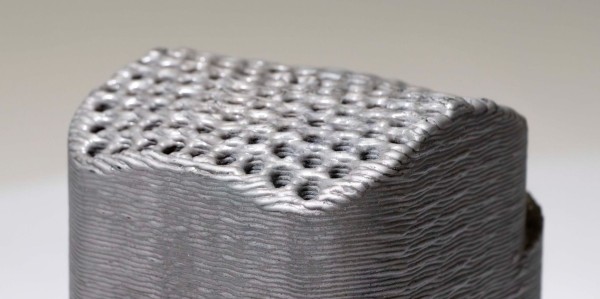
- Select the right profile: In Meltio Horizon or Meltio Space, choose the «Solid» profile for structural parts. This ensures the correct infill overlap and density settings.
- Consult the datasheets: Do not guess. Download the specific Meltio Material Datasheet (e.g., for SS316L or Ti64) to see the exact Yield, Tensile, and Elongation values.
- Perform coupon testing: For critical applications (TRL 7+), print your application and extract from it coupons to perform destructive testing (tensile bars) or non-destructive testing (micrographies or CT scan). It is important not to print coupons separately as their reduced scale compared to the part can behave differently, as being too small for the Solid profiles, intended for mid to large parts, check our material characterization handbook to know how we test and reach the specific structural properties.
- Post-Processing: If fatigue life is critical, consider heat treatments (stress relief, age hardening , annealig) or Hot Isostatic Pressing (HIP), although our as-printed density often negates the need for HIP, the size of argon molecules reduces its efficiency
TIP: Check Meltio Material Datasheets HERE.
6. Conclusion
Meltio is not a replacement for every manufacturing method. But for high-value structural components where lead time, geometrical complexity , multimateriality or material efficiency matter, Meltio’s W-LMD technology offers a mechanical performance profile that is no longer a compromise. It is a competitive advantage. We deliver forged-like quality with the geometric freedom of 3D printing.
FAQs
Generally, no. With relative densities reaching 99.97% as-printed, HIP is rarely necessary for general industrial applications. It may be used for mission-critical aerospace parts to close the final 0.03% of micropores.
Meltio offers significantly better process control, lower heat input (smaller HAZ), and finer resolution. While WAAM is faster for massive structures, it produces coarser microstructures and higher distortion. Meltio provides a superior balance of precision and mechanical integrity.
Yes. Because our feedstock is standard welding wire and the parts are fully dense metal, they behave exactly like billet material during welding or machining. We also can sequence several additive processes with their respective slicing strategies, so we are continuously doing this kind of operation.