How Ferrita customized a Mercedes Benz SLR McLaren exhaust using Wire-LMD
Ferrita Sweden AB is a Swedish company that develops and manufactures advanced technical solutions in sound attenuation, vibration, thermal insulation and exhaust gas purification, such as catalyst and particle filter purification. Led by CEO Micael, the company thrives within the Swedish car culture, a market where unique project cars are highly valued. This environment allows the team to be highly creative with exhaust design.
When a customer brought in a 2003 Mercedes Benz Slr McLaren, they wanted to go all in and make the vehicle completely special. The goal was to refine the hand uniquely built supercharged V8 dream car.
“There is a car culture in Sweden (as there probably is in the rest of the world) where uniqueness to one’s project car is highly valued, this lets us be very creative when it comes to exhaust design.”
1. Time constraints in aftermarket customization
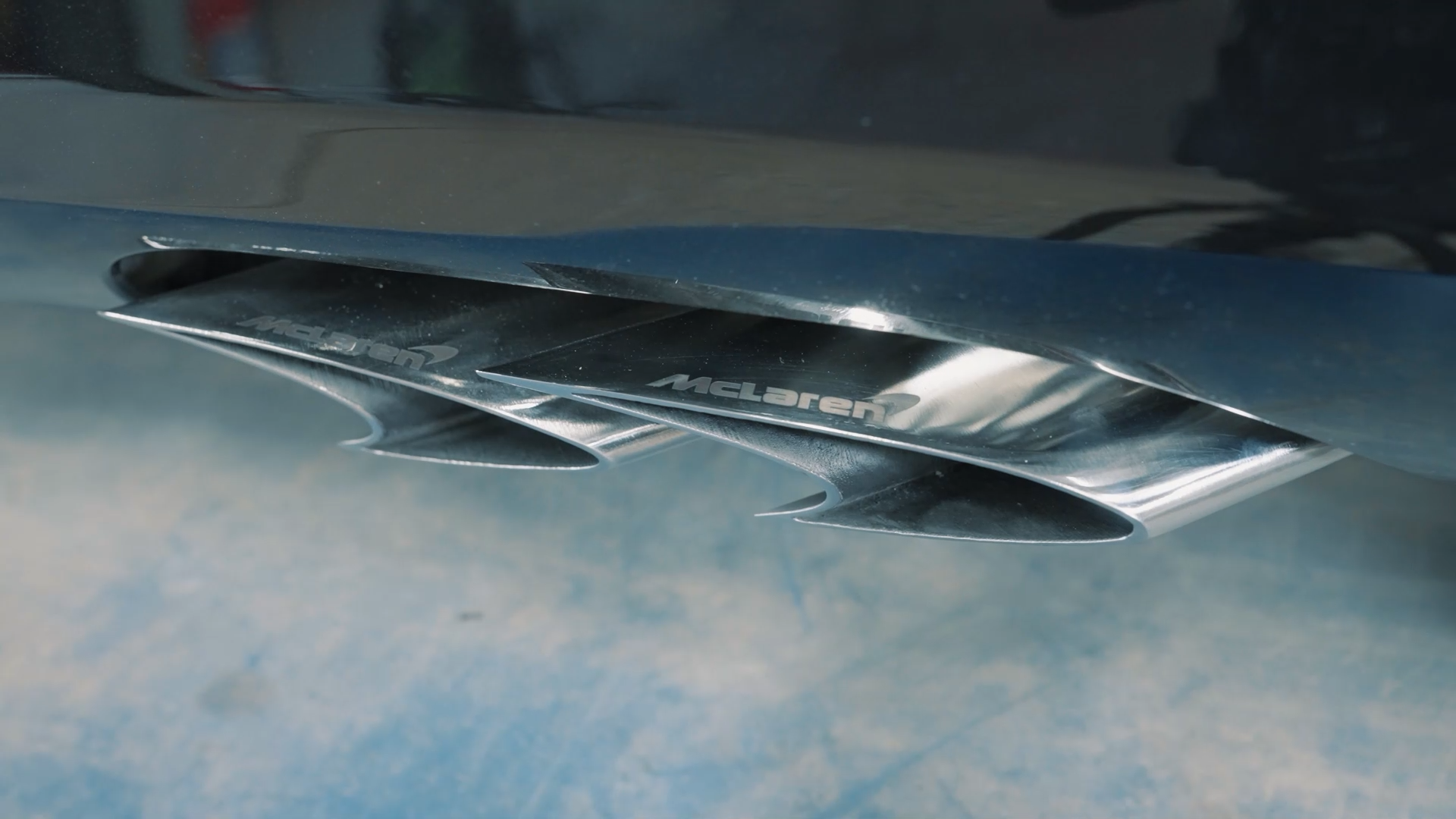
Producing highly specialized automotive components via traditional subtractive or forming methods introduces significant financial and temporal bottlenecks. For this specific build, Ferrita needed to manufacture four precisely symmetrical tailpipes with a highly specific shape. Traditionally, achieving this symmetry would require the shop to create special tooling. The financial burden of this conventional approach is substantial.
Furthermore, aftermarket fabrication shops operate under strict deadlines. Ferrita usually only has the customer’s car in the shop for about a week. Therefore, everything from the initial idea to the final manufactured part must proceed rapidly. Dedicating weeks and extensive budgets to custom tooling simply does not align with the agile workflow required in high-tier automotive customization.
2. Balancing complex geometries and lead times
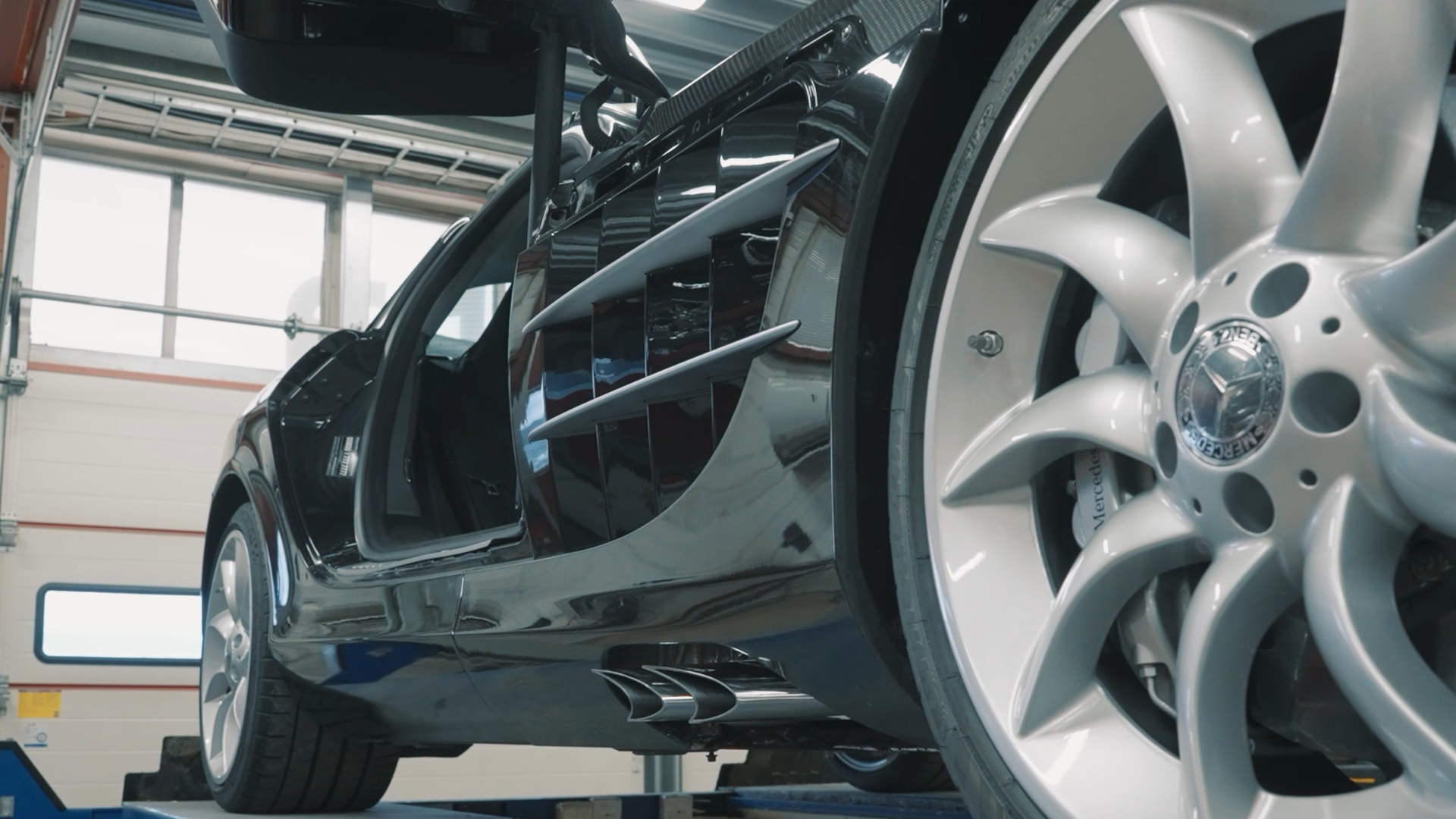
The engineering constraints on the Mercedes Benz SLR McLaren project were severe. The most immediate challenge was designing the components to perfectly match the existing lines of the vehicle. The packaging requirements were also extreme, as the original manufacturer attempted to fit an entire exhaust system inside the front fender. The team needed to replace the heavy original muffler, which weighed around 20 kilograms, to save a huge amount of weight and eliminate excess heat.
Beyond physical fitment, the team faced complex fluid dynamics challenges. Creating an ideal exhaust note requires precise manipulation of pipe dimensions, volumes, frequency changes, and exhaust velocity. Achieving optimal flow using conventional fabrication is extremely difficult. As Ferrita technician Viktor explains, “You can’t hand-produce a pair of merge pipes with round ends, flow-wise. You can make perfect merge pipes.” The shop needed a manufacturing method that could deliver flawless internal geometries to reduce back pressure, all while adhering to their rigid one week turnaround.
“To be internationally competitive, we entrusted Meltio and its 3D printing technology for the repair of our pieces, which helps automate the welding and repair process.”
3. An integrated scanning, CAD, and LMD workflow
Ferrita deployed an end-to-end digital and physical manufacturing pipeline. They started by scanning the bottom plate to visualize the exact space they had to work with, establishing a digital concept model to test fitment for the valves and pipes. Before using any metal, they printed a rapid plastic prototype in just a few hours to guarantee the design matched the car’s lines.
For final production, they utilized a Meltio Robot Cell. This machine utilizes an ABB robot and a laser head with nine laser beams to melt MIG wire. The tailpipes were manufactured out of 316 stainless steel. To ensure fine detail resolution, the system was programmed to run at 10 millimeters per second with a gas flow of 15 liters per minute, lowering the laser power to 1000 watts.
50% time and cost reduction
Achieved by Ferrita after incorporating Meltio's technology
4. Measuring the impact of Additive Manufacturing
Implementing wire laser metal deposition yielded significant quantitative and qualitative advantages:
Cost efficiency
Utilizing 3D printing bypassed the need for expensive tooling. A Ferrita technician highlighted the savings: "The time and cost of that for us would probably be close to 4000 euros, but now, when printing, doing the most to not complicate the part and printing it, probably cost us about half when accounting for all the polishing."
Material utilization
The wire LMD process is highly efficient. As noted during the build, "And an important part of this is actually that you have no waste, all material is used from the wire."
Production speed
Printing the stainless steel tailpipes took only about 4 to 5 hours.
Material flexibility
The printer can handle multiple materials in a single build. The system can start with inconel closest to the turbo and then switch to stainless steel.
Performance optimization
The technology allows engineers to easily manufacture complex components like four to one collectors overnight, enabling optimized internal flows and reduced back pressure.
Weight reduction
The new exhaust system replaced a heavy original muffler, saving around 20 kilograms of weight.
5. Shifting gears in automotive production
By combining creative engineering with a rapid additive workflow, Ferrita can deliver highly unique automotive projects faster than ever before. Moving from an imaginary concept to a physical part installed on a vehicle is now a seamless process. Utilizing laser wire metal deposition removes standard manufacturing bottlenecks, allowing fabrication shops to achieve mass production quality and exact repeatability on bespoke components.
“It is very easy to make a part. A collector, for example. A four into one, ready overnight.”