

From 10 hand-welded pieces to one printed pipe: Incredible Deere’s turbo manifold


Tractor pulling is a brutal sport. A modified tractor drags a weighted sled down a track until either the sled wins or the machine does, and the engines that make it work run far past anything you would find on a farm. Incredible Deere, a tractor-pulling team based in the Netherlands, lives in that world of constant rebuilding and tuning.
This season, the team fitted a new turbocharger. It was a clear upgrade, but it came with a problem that anyone who modifies engines knows well: the new part did not fit the old plumbing. The pipe that fed two smaller turbochargers into the engine’s main turbo had been built for the previous setup, and there was no quick way to adapt it.
K3D, one of Meltio’s trusted partners, and Incredible Deere already had a connection, and that turned into an agreement: K3D would scan, redesign and reprint the turbo distribution pipe using the Meltio Engine Integration kit for Industrial Robots, while the team kept working on the rest of the tractor.
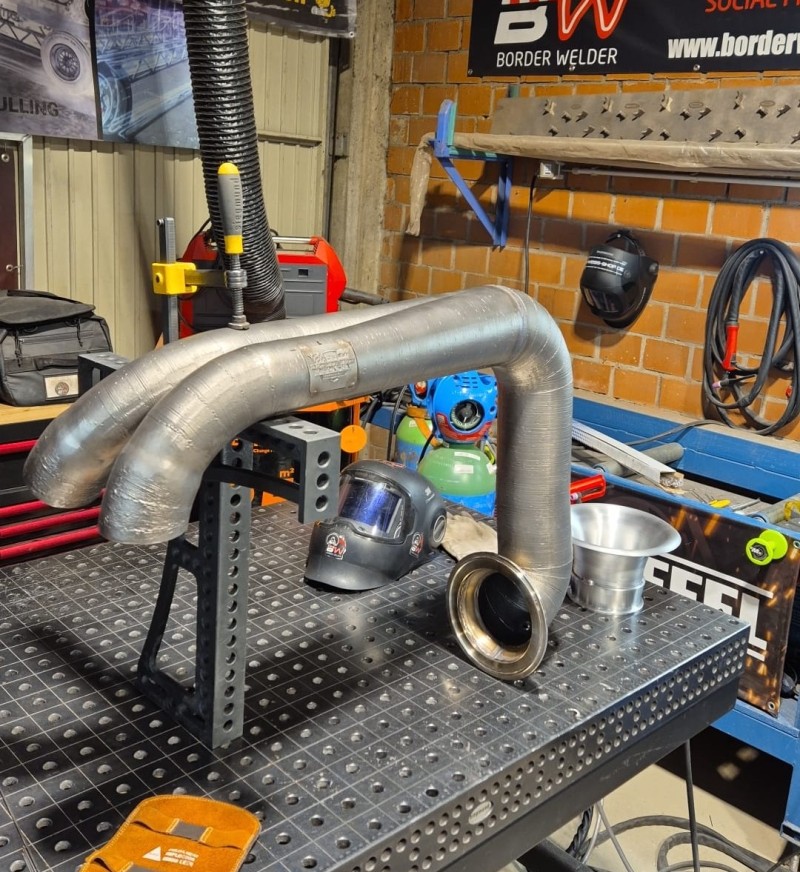
What the team wanted was simple: fewer welds, less hand-forming, and a part they could actually reproduce when they needed another one.
1. A hand-built part that was hard to reproduce
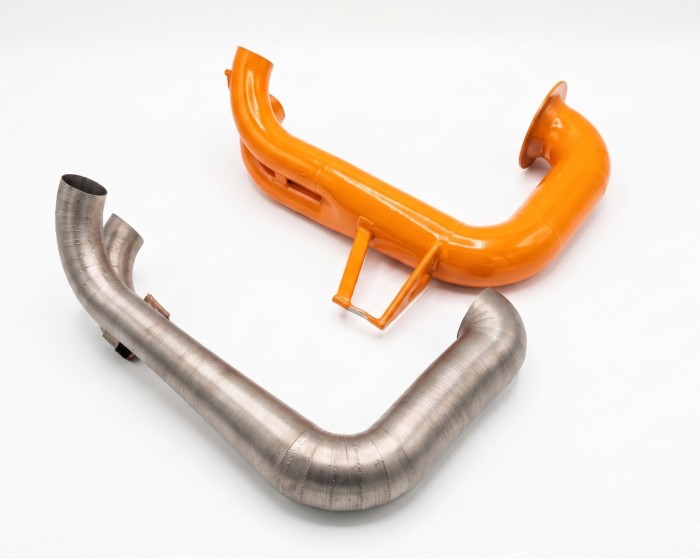
The original pipe, the orange version, was made entirely by hand. To get the shape right, the team hammered the tubing into form, welded it, then hammered it again. It worked, but it was slow, awkward and difficult to repeat, especially at the point where the pipe splits to feed the two turbos.
Underneath the finish, the part was complicated. It was an assembly of around ten welded pieces: conical sections, tubes of different diameters, and a non-standard “Y” junction that does not come off any shelf. Every one of those joints was a weld to make, a point to align, and a place where things could go wrong. What the team wanted was simpler: fewer welds, less hand-forming, and a part they could actually reproduce when they needed another one.
The original part was also carbon steel. For a machine that runs hard in a rough environment, that meant a surface more vulnerable to corrosion than the team wanted, and little chance of leaving the metal exposed as a clean design feature.
2. Rebuild a part that was never designed on a computer
The team encountered a series of obstacles:
The pipe had no CAD model
It had never been designed digitally. It existed only as a hand-built object, which meant there was nothing to print from and nothing to modify.
Geometry
A branching pipe with conical transitions, changing diameters and a Y-split is exactly the kind of shape that fights against a layer-by-layer process. Meltio’s machines hold to an overhang limit of 15 degrees, so any section that leaned out too far from vertical could not simply be printed as-is. The part had to be understood, segmented and oriented with that constraint in mind before a single layer was deposited.
Material change
Moving from carbon steel to stainless meant printing a part that would resist the aggressive conditions the tractor runs in and could be left bare for looks, while still matching the inlet and outlet positions of the existing engine assembly.

3. Scan, redesign, and print

Wire-laser metal deposition fits this job well: it builds near-net-shape parts directly from standard welding wire, with no powder to handle, so a complex one-off like this can go from scan to solid part without specialized feedstock.
4. Fewer welds, no hammering, and a team that kept working
Manual joining gone
The new pipe needs only two welds, pipe-to-pipe and pipe-to-flange, where the original assembly took six to seven.
Hammering is gone too
The team no longer has to beat tubing into shape and then correct it, the step that was hardest at the split in the pipe. The shape now comes from the digital model and the printer.
Work happened in parallel instead of holding up the build
While Meltio handled the entire process of producing the new pipe, Incredible Deere could keep working on the rest of the tractor.
The switch to 316 stainless steel does two jobs at once
It stands up better to the harsh environment the tractor runs in than the original carbon steel, and it lets the team leave the metal exposed as a finished surface rather than hiding it.
Objective adapted to a custom project
The goal they set was simple: to make the process easier and repeatable, and that is what the printed part delivers.
5. A repeatable part instead of a one-off
For Incredible Deere, the printed pipe is a part they can rely on and make again, rather than a hand-built object that lives only as long as it survives the track. For Meltio, it is a clean example of what wire-laser metal deposition does outside the headline industries: take a complex, non-standard part with no digital origin, and turn it into something designed, repeatable and production-ready.
That is the same shift Meltio is making across the board, from one-off prototypes toward parts that hold up as real production. A turbo pipe on a Dutch pulling tractor is a small piece of that, but it makes the point as well as anything: if the process can handle this, it can handle the part you have been building by hand.
FAQs
K3D printed the turbo distribution pipe, the manifold that feeds two smaller turbochargers into the engine's main turbocharger. The original was a hand-built assembly of around ten welded pieces, including conical tubes, sections of different diameters and a non-standard "Y" junction.
The team fitted a new turbocharger this season, and it no longer matched the existing hand-made pipe. Rather than reshape the old part by hand again, they worked with Meltio to scan, redesign and print a replacement that fit the current engine assembly.
K3D scanned the original pipe to digitize it, then redesigned that scan into a printable model while keeping the inlet and outlet positions fixed so the part still fit the tractor. The model was prepared in Meltio Space and printed on the Meltio Engine Robot Integration kit.
It was printed in 316 stainless steel wire. Stainless resists the harsh conditions the tractor runs in better than the original carbon steel, and it can be left exposed as a clean finished surface instead of being hidden.
The printed pipe needs only two welds, pipe-to-pipe and pipe-to-flange, compared with six to seven on the original assembly, and it removes the hand-hammering step entirely. The shape now comes from the digital model and the printer rather than from manual forming.