Additive Manufacturing in Oil & Gas: ExxonMobil’s transition to LMD for Titanium components
The oil and gas industry requires rigorous equipment reliability. At the ExxonMobil Baton Rouge refinery in Louisiana, protecting critical system panels from fluid contamination is key. This use case details the strategic transition from conventional subtractive manufacturing to Meltio’s Laser Metal Deposition (LMD) technology utilizing the Meltio M600 system.
It also shows how Titanium was never a material that ExxonMobil considered for its manufacturing operations. However, thanks to Meltio’s technology, they realized it’s not just a doable solution but a cost-effective one, without compromising the part quality and performance.
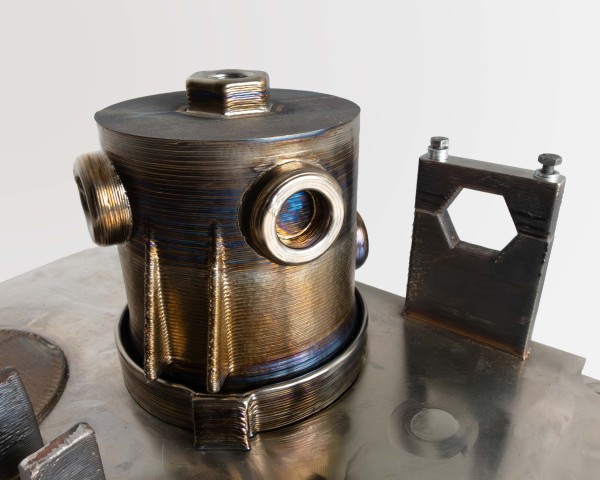
The final solution came from redesigning a protective machinery anti-wicking device. This allowed engineering teams to achieve structural improvements and compelling cost savings.
“Before wire-ded we never thought about having parts in titanium because it was very expensive but after moving to Meltio’s technology we discovered it’s quite affordable.”
1. Identifying the bottleneck
The existing anti-wicking device, designed to prevent oil from wicking up thermocouple wires into the instrument cabinet, suffered from significant design and operational limitations.
Limited mounting ability
The original bracket lacked a dedicated mounting system, relying entirely on a connecting conduit to support the heavy metal container amidst continuous industrial vibrations.
Operational downtime
The main body, a rigid cylindrical enclosure manufactured via conventional CNC turning and milling, prevented servicing of the internal separation plate without completely shutting down the machinery.
2. Moving to Titanium 64: Overcoming metallurgical and thermal constraints
The first decision was to move from the original material to a more efficient and effective one. After considering and testing several options, Titanium 64 was the chosen one: It is a lighter and cheaper material compared to the original one, and a material already parameterized with Meltio’s technology.
However, adapting these heavy-duty components for additive manufacturing presented distinct metallurgical and operational hurdles.
- Atmospheric requirements: The chosen material, Titanium 64, requires a strictly inert environment to achieve optimal microstructural properties. Generating this atmosphere demands approximately one and a half hours of machine time to remove oxygen prior to printing.
- Thermal constraints: Titanium requires a minimum layer time of seven minutes to avoid overheating, making standard single-part production inefficient due to excessive idle times.
- Deposition defects: Initial printing trials of the main body revealed surface oxidation caused by localized thermal accumulation, alongside material overbuilding on lateral clamping wings. Furthermore, rapid travel movements during printing physically shifted the unanchored main body, causing the laser to lose focus.
“Refinery equipment has to survive extreme conditions and constant vibration. By redesigning the component and locking it firmly in place during the printing process, we created a solid, leak proof titanium barrier that easily meets the strict reliability standards required by ExxonMobil.”
3. Strategic Additive Manufacturing: From custom tooling to advanced deposition
Engineering teams leveraged the Meltio M600 system to execute a complete part redesign tailored for 3-axis printing.
Custom fixture engineering
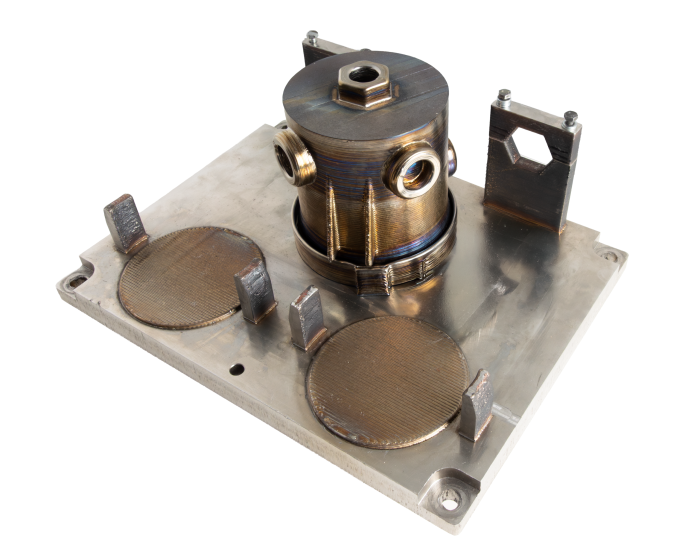
To maximize chamber inertization efficiency, engineers additively manufactured a custom fixture using SS-316Lsi deposited onto an SS304 base plate. This tooling enabled the batch production of four components simultaneously, naturally increasing inter-layer dwell times and eliminating surface oxidation issues.
Advanced deposition strategies
The main body was redesigned with a 75 degree overhang limit. To avoid complex support structures, the team implemented a non-planar printing approach. Using the M600 probing functions, the machine executed a Z-axis touch-off at the lowest substrate point, depositing features directly onto the curved surface. The lid was also redesigned to incorporate hollow perimeters specifically designed to hold a silicone sealant.
Parameter optimization
Material overgrowth was successfully mitigated by significantly decreasing laser power and print speed in specific localized regions. To prevent workspace displacement during non-extrusion travel moves, robust mechanical clamping was added to both sides of the fixture, locking the components rigidly into their coordinate systems.
Reduction of 42% in costs and a 90% in lead time
Achieved by ExxonMobil after incorporating Meltio's technology
4. Quantifying the impact
The transition to the Meltio LMD process yielded decisive operational advantages.
Financial efficiency
The unit cost for the complete assembly to a 42% cost reduction.
Lead time compression
Production lead time decreased drastically from an estimated 4 to 6 weeks down to exactly 58.8 hours.
5. Validating LMD as the future of Oil and Gas component manufacturing
Replacing CNC machining with LMD technology for Titanium 64 components offers strict geometric optimization and tangible financial returns. By addressing specific thermal behaviors and employing intelligent batch fixturing, ExxonMobil Baton Rouge successfully modernized a critical protective device.
The resulting 42% reduction in unit cost validates LMD as a highly competitive manufacturing solution for the demanding environments of the oil and gas sector.
“Moving away from traditional machining completely changed our production economics. We cut unit costs by 42 percent and shrank our lead times from six weeks to just under 60 hours, proving that additive manufacturing delivers real financial value to the oil and gas industry.”
FAQs
Titanium 64 was required for its superior material properties, but it presents two strict metallurgical constraints. First, it demands a completely inert atmosphere to achieve the desired microstructural integrity, requiring approximately 1.5 hours of machine time just to purge oxygen from the chamber. Second, to avoid localized overheating, the material requires a strict minimum layer time of 7 minutes.
Printing a single part would have resulted in excessive idle time. To solve this, the team designed and additively manufactured a custom SS-316Lsi fixture to batch-produce four components simultaneously. This strategy naturally increased the inter-layer dwell time, successfully preventing surface oxidation and maximizing the efficiency of the argon inertization process.
Instead of printing wasteful support structures for the variable cross-sections, the team utilized a highly experimental non-planar printing approach. By using the Meltio M600's probing functions, the system performed a Z-axis touch-off at the lowest point of the curved substrate, allowing planar-sliced toolpaths to be deposited directly onto a non-planar surface.
The transition to LMD generated a definitive financial advantage. The cost per unit dropped from $2,125.00 with conventional subtractive manufacturing to $1,222.50 with Meltio's process, achieving a 42% cost reduction. Furthermore, production lead times were compressed from an estimated 4-6 weeks down to just 58.8 hours.
The legacy anti-wicking device was a rigid CNC-machined cylinder that suffered from poor sealing, leading to oil leaks. Its design made it impossible to service the internal separation plate without completely shutting down the machinery. Additionally, it lacked a proper mounting bracket, meaning the heavy device relied entirely on a conduit to support its weight against continuous industrial vibrations.