



Building a rocket in a country without an existing rocket supply chain means every part is a decision, and some of those decisions are about the tooling before they are about the part. That is the position the Aerospace Systems Research Institute at the University of KwaZulu-Natal works from, developing an indigenous space launch capability for South Africa from the ground up.
One of the key components for their STEVE sounding rocket, currently under development, is the radax joint: the radial-axial interface that couples two rocket sections together and holds their alignment under load. It takes the form of a male and a female titanium ring, each 500 mm in diameter, that mate together to complete the joint. Under conventional rules, a ring that size means sourcing a titanium plate large enough to contain it, then machining almost all of that plate away.
ASRI believed there must be a more cost-effective way to get the required part and reduce the buy-to-fly ratio. So together with Petrawell and integration partner AMT3D, funded through the CPAM SMME Support Programme backed by the Department of Science, Technology and Innovation they decided to research the Additive Manufacturing route.
1. A ring too large to justify its own plate
A 500 mm ring machined from solid titanium plate carries the same economics as any large-diameter part cut from stock: most of the material leaves the shop as swarf, and the plate has to be large enough to contain the full ring before a single cutting pass begins.
Titanium plate at that scale is expensive to buy and often slow to source, and for a programme building a repeatable manufacturing capability rather than a single demonstrator, paying for material that never becomes part of the ring does not scale.
The team’s answer was to stop treating the ring as one part that needs one piece of stock, and start treating it as an assembly problem that additive manufacturing could solve directly.
2. Rebuild a part that was never designed on a computer
The tooling AMT3D designed (with the assistance of application engineers from Meltio) splits the build across two machines and three stages.
Stage one: substrate printing on the Meltio M600.
Titanium adheres best to Titanium, and that means that printing a Titanium alloy ring requires a substrate of a similar alloy. The economics of sourcing such a substrate, even though it would be re-usable, are close to those of making the ring out of a plate. The team therefore decided to print the required substrate as a ring in 4 segments, all fitting together on a standard Meltio M600 (or Meltio Robot Cell) Titanium build plate. A 10 hour print job to solve this otherwise challenging first step.
Stage two: assembly onto a steel build plate.
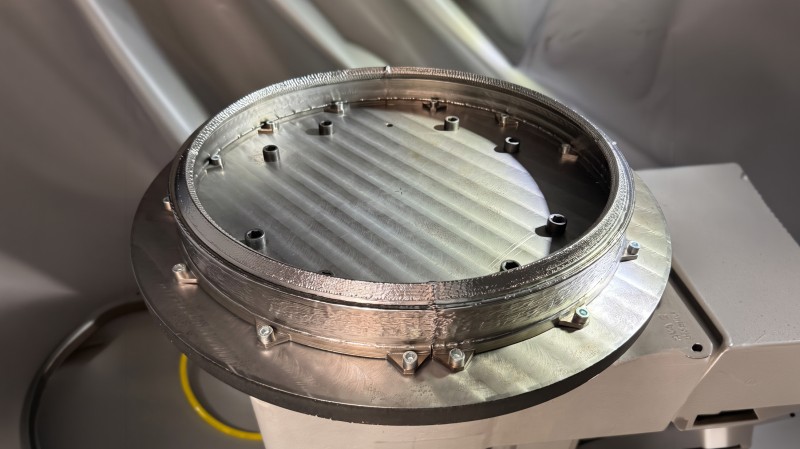
The four printed segments are removed from their build substrate and bolted onto a 600 mm diameter steel plate, where they are levelled by machining. This step turns four separate segments into one mechanically continuous ring, flat and true, ready to receive further deposition.
Stage three: finishing in the Robot Cell under an inert bubble.
The assembled steel plate, carrying the bolted titanium segments, is placed inside a Meltio Robot Cell fitted with an inert atmosphere bubble, where the ring printing is completed. The robot’s reach and the sealed inert environment handle what neither a standalone system nor an open-air process could: finishing a 500 mm titanium geometry cleanly, with the shielding control that reactive titanium demands at that scale.
Preparation began with machining the circular steel build plate. The first set of printed Ti64 support segments was completed on the Meltio M600, machined, and readied for assembly. A second set followed the same route. The inert bubble installation was the pacing item, after which printing began and both rings were completed. Combined print time across both rings totalled 78 hours.
Three things make this approach worth documenting beyond this one project.
It removes the titanium plate purchase entirely
The only titanium in the process is what gets deposited into the four segments. There is no large-format plate to source, hold in inventory or pay to have machined down to a fraction of its original mass.
It splits the build across the right machine for each stage
The Meltio M600 handles the segment geometry it is well suited to. The Meltio Robot Cell, with its reach and inert bubble, handles the large-diameter assembly finishing that a standalone system's envelope cannot. Neither machine is tasked to do the whole job alone.
The tooling is reusable
A build strategy based on segmenting, bolting to a machined plate and finishing under an inert bubble is not specific to one ring. It is a method ASRI and AMT3D can apply to the next large-diameter titanium structure on the roadmap, including their orbital Commercial Launch Vehicle (CLV)-scale components ahead.

3. A large ring without a large plate
With both rings now printed, the project has proven the core claim of the tooling strategy before a single cost figure is published.
No large titanium plate purchase, at any point in the process
The material budget is set by what gets deposited into the segments, not by the stock a 500 mm plate would require.
A large-diameter part built entirely on standard-envelope machines
Neither the Meltio M600 nor the Meltio Robot Cell had to be sized to the finished ring; the tooling did that work instead.
A repeatable method, not a one-off fix
The segment-and-assemble approach is a template for the next large ring, not a workaround built for this one.
The full chain stays local
From segment printing through to final component machining to final assembly, supported by Petrawell and AMT3D's integration work in South Africa.
The next phase is machining and assembling the finished rings into the completed radax joint, which is where the project’s cost and performance case will ultimately be made.
Three properties of the process make it the right fit here.
Wire, not powder.
ASRI put the argument plainly: “Wire feedstock is commercially available, comparatively easy to handle and more aligned with industrial production environments than loose reactive titanium powder.” For a team building toward local production rather than a lab demonstration, that difference in handling, storage and safety is not a footnote. Titanium welding wire can be bought and stored like any other consumable.
A hybrid chain that ends in a machine tool.
Nothing flies as-deposited. The workflow was designed from the outset as print, heat treat, scan, machine, wire-cut, inspect, which means the preform only has to be good enough to machine. That is a far more forgiving target than good enough to fly, and it is why near-net-shape works as a production strategy rather than a compromise.
The same process on two platforms.
Running the part on an Meltio M600 and on a Meltio Robot Cell matters more than it looks. The Meltio M600 is a standalone system with a controlled envelope; the Meltio Robot Cell is the path to larger structures. Proving one process across both means the method ASRI develops for a 500 mm joint does not have to be reinvented for the bigger CLV components on the roadmap.
4. The tooling is the story
Most metal additive manufacturing stories are told through the part. This one is told through the tooling that made the part possible without the titanium plate purchase the conventional route would have demanded. Splitting a 500 mm ring into four printed segments, assembling them onto a machined steel plate, and finishing the build inside an inert-atmosphere robot cell is not a shortcut. It is a manufacturing method, and one ASRI, Petrawell and AMT3D can now carry forward to the next large titanium structure on South Africa’s launch vehicle roadmap.


FAQs
A radax, or radial-axial, joint is the structural interface that couples two sections of a launch vehicle together and holds their alignment under load. On ASRI's STEVE sounding rocket, the radax joint is made up of a male and a female titanium ring, each 500 mm in diameter, that mate together to form the joint.
By splitting the build across the process rather than the machine. ASRI, Petrawell, and AMT3D print the substrate ring in four segments on a Meltio M600, bolt the segments to a machined 600 mm steel plate, and finish the printing inside a Meltio Robot Cell under an inert atmosphere bubble. This avoids the need for a substantial expenditure in tooling.
Machining a 500 mm ring from a titanium plate that size means paying for material that mostly ends up removed as swarf, and sourcing titanium plate at that scale is costly and often slow.
An inert bubble is a sealed, gas-shielded environment built around the print zone inside the Robot Cell. Titanium is reactive at high temperature and takes up oxygen from the surrounding air, so shielding quality determines whether a printed section is usable or not. Printing the 500 mm ring inside an inert bubble gives the process the atmospheric control that a large, open build would not have.
Both titanium rings have been printed over one segmented substrate, with a combined print time of 78 hours. The next phase is machining and assembling the printed rings into the completed radax joint.